How Much Money Do You Need to Flip a House? Cash to Close vs. Cash to Finish
How much money do you need to flip a house? On a $250,000 house with $50,000 in renovations, a 10% down payment is $25,000, but closing costs, contractor advances, interest, and reserves can bring illustrative available cash to about $72,000.
Your actual amount depends on financing and timing. Backflip helps you analyze costs and explore loan options for your property.
The short answer: The cash you need at closing is not the same as the cash you need to finish the flip. A fix-and-flip loan can finance part of the purchase and potentially all eligible renovation costs, but you still need a plan for fees, contractor payments, holding expenses, and surprises.
Want to know your actual cash requirement?
See your fix-and-flip loan optionsAnalyze a deal for free
2026 flipping by the numbers
| Stat | What it means | Source |
|---|---|---|
| 61.1% | Of flipped homes purchased with cash, Q1 2026 | ATTOM data |
| $72K | Average rehab spend in Q3 2026 investor survey | John Burns + Kiavi |
| 161 days | Typical purchase-to-resale time in Q2 2026 | ATTOM data |
Different data sources and periods; not expected results for an individual project.
In this guide
- What costs do you need to flip a house?
- Example: A $250,000 flip with a $50,000 renovation
- How do fix-and-flip loans change your upfront cash needs?
- Which Backflip loan option fits your flip?
- How to know whether your flip is worth financing
- How to get started with Backflip
- Frequently asked questions
What costs do you need to flip a house?
Your purchase price is only the starting point. Before you make an offer, build a budget around these five expenses:
- Down payment. The portion of the purchase price your lender doesn’t finance. On a $250,000 purchase, 10% is $25,000; 20% is $50,000. These are examples, not guaranteed loan terms.
- Loan and closing costs. Origination fees (the lender’s charge for making the loan), title and settlement fees, insurance, recording charges, and other property-specific expenses. One point is 1% of the loan amount; two points on a $275,000 loan equal $5,500.
- Renovation costs. Contractor labor, materials, permits, and unexpected repairs. In the Q3 2026 John Burns/Kiavi survey, 43% of respondents spent $30,000 to $70,000 on renovations, but costs varied widely by market.
- Holding costs. Interest, taxes, insurance, utilities, maintenance, and potential extension costs while the property is being renovated and waiting to sell.
- Selling costs and reserves. Agent commissions or other negotiated selling fees, seller closing costs, and money set aside for project delays or work that exceeds the budget.
Watch the timing. A loan that covers renovation work may release those funds in stages rather than upfront. You may have to pay a contractor before receiving the next reimbursement.
That’s why a deal can require more available cash than its down payment suggests.
Example: A $250,000 flip with a $50,000 renovation
Let’s use one hypothetical property throughout the article. These are teaching figures, not a Backflip loan quote or a typical borrower outcome.
| Property assumptions | Amount |
|---|---|
| Purchase price | $250,000 |
| Renovation budget | $50,000 |
| Purchase + renovation | $300,000 |
| Estimated resale value after renovation (ARV) | $390,000 |
After-repair value (ARV) is what a property may be worth once planned renovations are complete. It should be based on recent sales of comparable renovated homes, not the highest asking price nearby.
How much would the loan cover?
Assume a hypothetical lender finances 90% of the purchase ($225,000) and approves $50,000 for renovation work to be released through draws. The total loan commitment would be $275,000 and the down payment would be $25,000. This is a high-leverage illustration, not a published Backflip program guarantee.
Cash to close versus cash to complete the project
| Cash requirement | Illustrative amount |
|---|---|
| Down payment | $25,000 |
| Loan origination fee (assumed 2% of $275,000) | $5,500 |
| Other acquisition closing costs | $4,500 |
| Estimated cash due at closing | $35,000 |
| Cash available for initial contractor payments | $12,000 |
| Budgeted interest during the project | $12,000 |
| Taxes, insurance, utilities, other holding costs | $3,000 |
| Contingency reserve | $10,000 |
| Illustrative total cash availability | $72,000 |
The $72,000 is not a single payment and does not mean $72,000 gets spent. Contractor advances may be reimbursed by renovation draws, and an unused contingency remains your money.
It also is not a calculated minimum peak cash balance: actual liquidity needs depend on when bills come due, draw timing, and lender reserve requirements. The table excludes possible per-draw fees and any other unmodeled expenses.
The difference matters: $35,000 could get this hypothetical deal closed, but you need additional working cash to see it through. Your actual loan structure can change both amounts substantially.
Use your property, not a generic example.
Get preliminary terms for your dealRun these numbers in Backflip
What would the flip actually earn?
Assuming the property sells for $390,000, here’s a simplified estimate:
| Projected sale and expenses | Amount |
|---|---|
| Resale price | $390,000 |
| Purchase and renovation | -$300,000 |
| Origination and acquisition closing costs | -$10,000 |
| Interest and other holding expenses | -$15,000 |
| Selling costs (illustrative 6%) | -$23,400 |
| Estimated profit before income taxes and unexpected costs | $41,600 |
That’s about 11.9% of the $348,400 in modeled project costs. If the full $10,000 contingency is spent on additional repairs, estimated profit falls to $31,600. This simplified example excludes draw fees and other costs not explicitly shown.
One more reality check: the familiar 70% rule gives a maximum preliminary offer of $223,000 for a $390,000 ARV and $50,000 renovation budget ($390,000 x 70% – $50,000). Our $250,000 purchase exceeds that shortcut.
It doesn’t automatically make the deal unworkable, but it does mean you should examine the full numbers rather than rely on the rule alone.
How do fix-and-flip loans change your upfront cash needs?
A fix-and-flip loan, often called a hard money loan, is short-term financing used to buy and renovate an investment property. It can help you avoid paying the full purchase and renovation cost in cash, but the structure matters as much as the headline rate.
Before choosing a lender, ask:
- How much of the purchase will be financed? A high advertised loan-to-cost figure doesn’t necessarily mean the same percentage of the purchase price will be advanced at closing.
- When do I receive renovation funds? Funding for up to 100% of eligible repairs may still be reimbursed after completed work is verified.
- What do fees and interest cost over my expected timeline? Compare origination points, interest, draw fees, and potential extension costs, not just the rate.
- How much cash must I show in reserves? A lender may require proof of funds beyond the amount due at closing.
Loan-to-cost (LTC) means the loan amount divided by the purchase price plus eligible renovation costs. For example, a $270,000 loan on a $300,000 purchase-and-rehab budget is 90% LTC. The lender may also limit financing based on the property’s value after renovation.
Backflip offers financing for up to 100% of approved renovation costs for qualified borrowers, with rehab funds requested through its platform as eligible work progresses. Its published app materials also describe interest charged only on funds actually disbursed, not on undrawn rehab money.
Terms and availability depend on the loan and underwriting. See Backflip’s loan options.
Which Backflip loan option fits your flip?
There’s no single best financing structure for every investor. Backflip combines deal analysis and loan options so you can compare what matters for your property.
| Backflip option | Main priority | What to understand |
|---|---|---|
| Standard | Lower interest costs | Backflip positions this as its lowest-rate fix-and-flip option. Lower borrowing costs may suit investors who don’t need maximum leverage. |
| Altitude | More financing, less cash tied up at closing | Higher leverage can preserve working capital, but your loan amount, rate, and cash requirement still depend on eligibility and the property. |
| Zero Gravity | More breathing room on monthly payments | Published program materials describe up to six months without monthly interest payments for eligible borrowers. Accrued interest and applicable fees are deferred, not forgiven. Confirm current availability and payoff terms. |
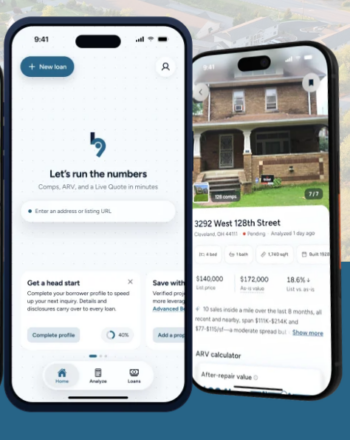
What makes Backflip useful here: You can analyze a property, review nearby comparable sales (comps), estimate ARV, enter rehab and holding costs, and view preliminary personalized financing in the free Backflip app. Once you start a loan inquiry, a dedicated lending contact can help confirm the actual terms.
You can also track processing and request rehab draws in the platform. See the new Backflip app.
Compare financing that matches your goals.
See your Backflip financing optionsTry the free Analyzer
How to know whether your flip is worth financing
A loan can reduce the cash you need upfront. It can’t make an overpriced purchase profitable. Before making an offer:
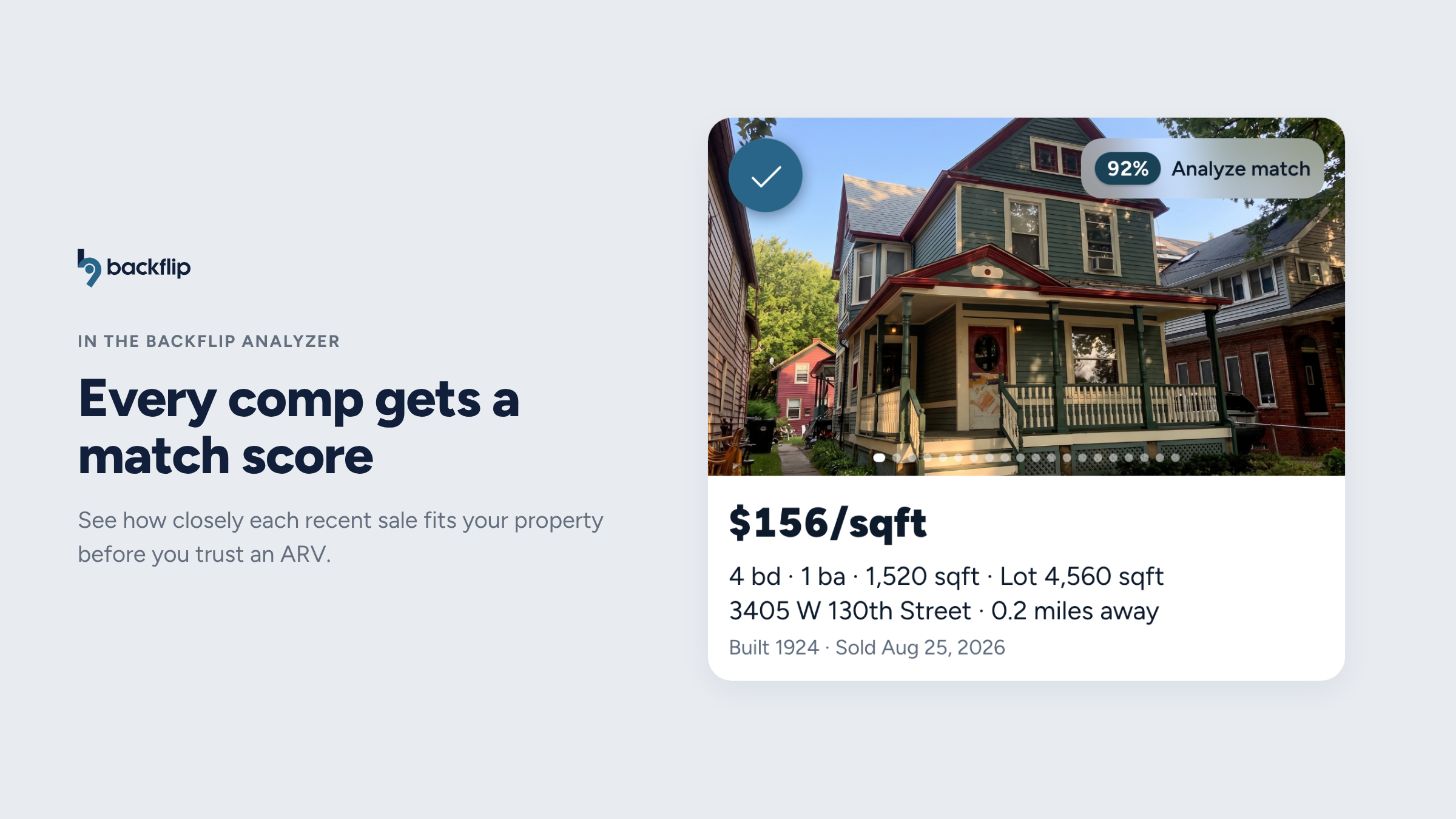
- Check recent sold comps. Prioritize similar homes in the same area and condition. Backflip’s Analyzer gives nearby sales a comp match score and lets you review which comps support your projected ARV.
- Get a detailed renovation estimate. Separate labor, materials, permits, and contingency instead of using a single round number.
- Model a slower sale. Test what happens if renovations or resale take one or two extra months. Carrying costs continue after the construction work is finished.
- Compare your total costs with the resale price. Include financing, acquisition, renovation, holding, and selling expenses before calculating profit.
This matters more as margins narrow. ATTOM reported $60,526 in typical gross flipping profit and a 21.5% gross return in Q2 2026. Those figures do not deduct renovation, financing, and other costs.
And in the Q3 2026 John Burns/Kiavi survey, 20% of respondents said their flips sold mostly below their original ARV estimates; among that group, 84% said they had overestimated the sale price. Read the survey.
Backflip has also published its own joint analysis with ATTOM across six markets using loan origination and property sale data. One telling contrast: the study reported 28.4% gross ROI in Boston versus 4.3% in Dallas-Fort Worth in Q1 2026. Those market-level gross returns aren’t net project profits, but they show why purchase price and exit assumptions should come before financing decisions.
How to get started with Backflip
You don’t need to guess what a generic lender might offer. Start with the property you’re considering:
- Analyze the address. Use the free Backflip Analyzer to review comps, estimate ARV, and enter purchase, renovation, holding, and selling costs.
- Review preliminary financing. See indicative loan options and estimated cash to close based on the deal information you provide. These are not final loan approvals.
- Request a loan. Submit a non-binding inquiry to speak with the Backflip lending team about your project, eligibility, and final financing terms.
Ready to run the numbers on your next flip?
Get your fix-and-flip loan termsAnalyze a property for free
Frequently asked questions
Can you flip a house with $30,000?
Possibly, depending on the property, financing, and reserves. But $30,000 may not cover closing fees, contractor advances, holding expenses, and surprises on a typical project. Run a complete cash-flow estimate before assuming it’s enough.
Can you flip a house with no money down?
Some investors bring in partners or use other financing arrangements, but that doesn’t mean the project is free or risk-free. Someone still has to cover the purchase contribution, closing costs, expenses, and reserves.
How much is the down payment on a fix-and-flip loan?
It varies by lender, borrower experience, property, and program. The percentage advertised for total project financing may not equal the percentage funded toward the purchase price. Ask for a deal-specific cash-to-close estimate rather than relying on a general range.
Does a fix-and-flip loan cover renovations?
Many do. Backflip advertises financing for up to 100% of approved rehab costs for qualifying loans. That doesn’t mean the full renovation budget is handed to you at closing: draw funding generally follows verification of completed work.
How much cash do you need to flip a $250,000 house?
In the hypothetical example above, the down payment is $25,000, the estimated cash due at closing is $35,000, and total illustrative cash availability is $72,000. Actual amounts depend on lender terms, renovation costs, payment timing, and reserves.
Is Backflip a good option for a first-time flipper?
Backflip’s Standard option and free Analyzer may be worth considering for eligible first-time investors who want to evaluate a deal and explore financing in one place. Eligibility, leverage, pricing, and available loan programs must be confirmed for the individual borrower and property.
Sources and methodology
- ATTOM Q1 2026
- ATTOM Q2 2026
- John Burns + Kiavi Q3 2026 survey
- Backflip + ATTOM market analysis
- Backflip app and loan terms
All example financing and expense assumptions are hypothetical. ATTOM’s gross-profit figures are not net profits. Survey findings represent respondents, not every U.S. flipper.
Financing disclaimer: This article is informational, not a loan offer or a guarantee of approval. Rates, fees, loan amounts, leverage, product availability, and repayment terms are subject to change, qualification, and underwriting. Estimates are not financial, legal, or tax advice.