6 Best Fix and Flip Apps and Analysis Tools
A profitable flip depends on getting a few decisions right, and getting them right quickly: what the property will be worth after renovation, what the rehab will cost, and whether the projected return justifies the offer. The best fix and flip apps bring those decisions into one place, so investors are not moving data between a comparable-sales tool, a spreadsheet, and a lender portal to evaluate a single deal.
This guide compares the six best fix and flip apps and analysis tools for single-family investors. Each platform is assessed on the capabilities that matter most under a real closing timeline: on-site deal analysis, financing that connects to that analysis, rehab budgeting, draw management, and whether the product is built for how investors actually operate. Backflip earns the top position because it connects deal sourcing, analysis, and funding within one application. The five alternatives each address a narrower part of the process.
Because this category relies heavily on acronyms, a few definitions will help.
- ARV (after-repair value): is what a home is worth once the renovation is complete.
- ROI (return on investment): measures profit against the capital invested. LTC (loan-to-cost) expresses the loan as a percentage of purchase price plus rehab.
- LTARV (loan-to-after-repair-value): measures the loan against that projected finished value.
Additional terms are defined as they appear.
Quick guide: the 6 best fix and flip apps for single-family investors
- Backflip: the best all-in-one app & platform for finding, analyzing, and funding fix-and-flip deals from a phone.
- Kiavi: a technology-driven lender with only an online pricing portal for experienced investors.
- Lima One Capital: a private lender with customizable term lengths and deferred origination-fee options.
- RCN Capital: a nationwide lender with leverage tiered to borrower track record.
- Groundfloor: a passive investing platform for funding other investors’ fix-and-flip projects rather than running your own.
- LendingOne: a direct lender with fast closings and mobile draw submissions.
How we chose the best fix and flip apps and analysis tools
Each platform was evaluated from the perspective of an active investor working against a closing deadline, rather than from a marketing feature list. Six criteria guided the comparison.
- Mobile deal analysis: Can an investor pull comps and estimate ARV in the field without returning to a laptop? Speed at the property reduces hours of later second-guessing.
- Integrated financing: Does the analysis connect directly to a loan application? Fewer handoffs mean faster closings and fewer re-entered figures.
- Rehab budgeting: Can renovation costs be estimated in enough detail to protect the margin? A single lump-sum figure is not a budget.
- Loan management: Once a loan is funded, can draws, disbursements, and project milestones be tracked in one place? A misplaced draw can cost days.
- Investor-specific design: Is the tool built for fix-and-flip workflows, or is it a consumer mortgage product with an investor label? The underwriting and terminology should reflect how investors run deals.
- Scalability for repeat investors: Does the platform reward volume with better terms or lower fees? A tool that treats a tenth flip like a first one is not built to scale with the business.
The 6 best fix and flip apps for single-family investors
1. Backflip: best overall fix and flip app
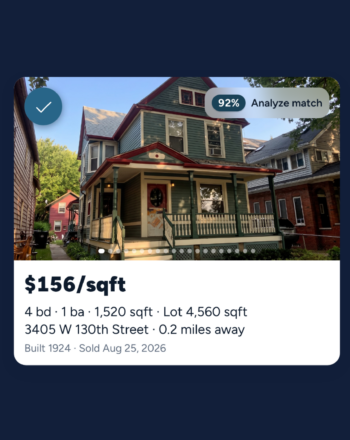
Backflip is an end-to-end platform & mobile app built for residential real estate investors who flip single-family homes. The mobile app brings deal sourcing, comp analysis, profit forecasting, and loan applications into one workflow that can be run from a job site, an open house, or a desk. Where most platforms require investors to export data between a comp tool, a spreadsheet, and a lender portal, Backflip keeps the workflow connected: investors pull comps, calculate ARV, estimate a rehab budget, and submit a request for a loan inquiry with the Backflip team without leaving the app.
The Backflip Analyzer pulls comparable sales, highlights the most relevant comps, and forecasts profit, ROI, and cash-to-close, so an investor can confirm whether a deal clears a target return before making an offer. These comp and ARV tools are free to every user, with no subscription required to analyze a deal.
The app also connects that analysis directly to Backflip’s financing. When a deal meets an investor’s criteria, a pre-qualification and loan application can be started from the same screen. Pre-qualification uses a soft credit check, which does not affect the borrower’s credit score, allowing investors to review terms on a non-binding basis before committing.
Backflip’s fix-and-flip loan programs
Rather than a single rigid loan, Backflip offers several fix-and-flip loan products so financing can be matched to the deal and what the investor needs with rates starting at 7.5% and typical origination fees of approximately 1.25% to 2%:
- Standard: the lowest cost of capital, designed for investors who want to prioritize interest expense over maximum leverage.
- Altitude: higher leverage for investors who want to finance more of a project and preserve capital for the next acquisition. Backflip advertises maximum leverage up to 96% LTC on eligible financing.
- Zero Gravity: up to six months with no monthly interest payments for qualifying borrowers, with interest and fees capitalized into the loan and repaid at completion. These costs are deferred, not eliminated, a distinction worth understanding before selecting the program.
Backflip also finances ground-up New Construction is select markets on 1 to 4 unit residential projects (including accessory dwelling units) for experienced and expert borrowers, and offers DSCR rental financing for investors who want to transition a completed flip into a long-term rental. DSCR (debt-service coverage ratio) is a rental-loan approach that qualifies the property on its own cash flow rather than on personal income alone. Together, these programs provide more than one exit path from a single platform.
Backflip Rewards: lower fees as you scale
Active investors pay origination fees on every transaction, so even a modest discount compounds over a year of deals. Backflip Rewards reduces the origination fee based on eligible loans closed directly with Backflip over a rolling 24-month period:
| Eligible closed loans | Origination-fee discount |
|---|---|
| 1 | 0.10 percentage points |
| 2 | 0.20 percentage points |
| 3 | 0.30 percentage points |
| 4 | 0.40 percentage points |
| 5 or more | 0.50 percentage points |
On a $300,000 loan, the maximum 0.50-percentage-point discount reduces a 1.5% origination fee to 1.0%, which represents $1,500 retained in the project on a single transaction. Rewards are subject to eligibility, opt-in, and program terms, and broker-originated loans generally do not qualify.
Deal sourcing and draw management
For investors who source their own leads, Backflip’s My Leads allows them to define a buy box (target price, location, and property criteria) and surfaces matching properties, so opportunities live in the same place they are analyzed and funded. Once a loan is active, the virtual draw process lets borrowers submit draw requests and track renovation disbursements from a phone, with access to a dedicated draw team throughout the project. For newer investors, a draw is a reimbursement of completed renovation work, released in stages after an inspector verifies it.
Pros:
- Combines deal sourcing, analysis, and financing in a single mobile application, which removes the need to re-enter data across separate tools.
- Free ARV and comparable-sales tools for every user, with no subscription required to analyze deals.
- A rewards program that lowers origination fees for repeat borrowers, with no upfront lender fees before closing.
Cons:
- Lending is available in select states, with coverage expanding over time.
- The platform is built for single-family residential investing, so investors focused on large multifamily or commercial transactions may require additional tools.
- As a newer entrant relative to some legacy lenders, Backflip continues to build its public track record.
Explore Backflip’s fix-and-flip financing and get your personalized terms.
2. Kiavi: a technology-driven lender with online pricing
Kiavi uses a technology platform and a large dataset of funded projects to price fix-and-flip loans. Its online portal generates estimates from property-level data rather than traditional income documentation, and the lender advertises interest-only term options and no application or appraisal fees on its fix-and-flip financing. Kiavi services its loans in-house, which keeps the borrower relationship under one roof from application through payoff.
Pros:
- A digital platform that reduces manual paperwork during the application.
- Online pricing and pre-qualification without a traditional income file.
- In-house servicing keeps communication centralized after closing.
Cons:
- It is a lender rather than a deal-analysis platform, with no built-in comp or ARV tools, so deals are analyzed elsewhere and the figures re-entered.
- Programs are oriented toward experienced investors, so first-time investors may find fewer guardrails.
- No property sourcing, so a separate tool is still needed to find deals.
3. Lima One Capital: customizable loan terms
Lima One Capital offers fix-and-flip loans across a range of term lengths, with separate products for fix-and-flip, fix-to-rent, and bridge scenarios. The lender advertises up to 95% LTC for eligible projects, financing for 100% of the renovation budget, and the option to defer origination-fee payment until the property exits, which can reduce the cash required at closing. It also publicizes a materials-discount partnership for renovation supplies.
Pros:
- Flexible term lengths allow financing duration to be matched to the project.
- Deferred origination-fee options reduce cash-to-close on qualifying deals.
- Separate products for flip, rent, and bridge strategies.
Cons:
- No integrated deal analysis or property sourcing on the platform.
- Borrower evaluation still relies on traditional documentation.
- With any deferred-fee structure, investors should confirm whether it changes the total amount or timing of what is owed.
4. RCN Capital: leverage tiered to your track record
RCN Capital structures fix-and-flip leverage around investor experience. The lender advertises that newer investors with no completed flips qualify for a lower share of the purchase price, while experienced investors can access higher leverage on purchase plus renovation costs, subject to a cap against ARV. RCN finances a range of property types and states that it charges interest only on the outstanding balance rather than on undrawn rehab funds, which lowers carrying costs during the renovation.
Pros:
- Experience-based tiers reward a track record with higher leverage.
- Interest is charged on drawn funds only, not the full rehab holdback.
- Supports a range of property types.
Cons:
- Newer investors receive lower leverage, which requires more cash at closing.
- No mobile deal-analysis app is bundled with the loan.
- No integrated property sourcing or comp tools.
5. Groundfloor: passive investing, not active flipping
Groundfloor serves a different purpose than the other platforms on this list. Rather than lending to active investors, it allows individuals to invest in short-term real estate debt and earn returns from borrower interest payments. Both accredited and non-accredited investors can fund individual projects or purchase fixed-rate notes backed by a pool of loans, with low minimums that make real estate debt accessible. Groundfloor publicly reports more than $1 billion in investments across its platform.
Pros:
- Open to both accredited and non-accredited investors.
- Project-level detail on the deals being funded.
- Low minimums and multiple product types.
Cons:
- It is designed for passive investors funding projects, not for investors running their own rehabs, so it does not fit the on-site workflow this guide addresses.
- Returns depend on borrower repayment, which carries credit risk on individual projects.
- No property sourcing, comp tools, or rehab budgeting.
6. LendingOne: fast closings with mobile draws
LendingOne is a direct lender that advertises fast closings and desktop appraisal options for quicker funding. It publicizes high loan-to-cost leverage, financing for renovation costs, and interest charged only on disbursed funds. Borrowers can submit draw requests from a phone, and the lender offers a fix-to-rent product that supports investors moving from a flip into a rental through a buy, rehab, rent, refinance, repeat (BRRRR) strategy.
Pros:
- Fast closings for qualifying deals.
- Mobile draw submissions reduce turnaround on renovation funding.
- A fix-to-rent option for BRRRR investors.
Cons:
- No deal-analysis, comp, or ARV tools on the platform.
- No property sourcing or lead management.
- Desktop appraisal eligibility varies by property and loan scenario.
Comparison table: the best fix and flip apps at a glance
| Platform | Built-in deal analysis | Integrated lending | Mobile app | Best for |
|---|---|---|---|---|
| Backflip | Yes (ARV, comps, profit forecasting) | Yes (fix & flip, new construction, DSCR) | Yes (iOS & Android) | Finding, analyzing, and funding deals in one app |
| Kiavi | No | Yes (fix & flip, bridge) | No | Experienced investors who price online |
| Lima One Capital | No | Yes (fix & flip, rental, bridge) | No | Flexible terms and deferred fees |
| RCN Capital | No | Yes (fix & flip, rental) | No | Leverage based on track record |
| Groundfloor | No | No (passive investment platform) | Yes (iOS & Android) | Passive investors funding projects |
| LendingOne | No | Yes (fix & flip, rental) | No | Fast closings and mobile draws |
Comparison based on each lender’s publicly available program information. Published figures are not personalized offers, and fee or leverage structures are not necessarily equivalent across lenders. Rates, limits, fees, and eligibility depend on the borrower and the transaction.
What should you look for in a fix and flip calculator?
A fix and flip calculator should do more than multiply ARV by 70% and subtract repair costs. The most useful ones account for acquisition costs, holding costs, financing costs, and selling costs within a single model, so the result reflects actual projected profit rather than a rough margin.
Investors should favor tools that pull comparable sales automatically rather than requiring an ARV to be entered by hand. A manually entered ARV carries the bias of the person entering it, while a calculator that draws comps from public records and MLS data provides a starting point grounded in recent transactions. (MLS, the multiple listing service, is the database agents use to list and track sales.)
The level of rehab detail matters as well. A single field for “renovation costs” obscures the line items that drive overruns. Stronger tools allow the budget to be broken into categories such as kitchen, bath, and cabinetry, so actual spend can be tracked against the estimate during the project. That level of detail is what separates a budget from a guess.
How mobile apps improve on-site deal analysis
When an investor is standing in a property with a motivated seller present, there is rarely time to return to a laptop to run comps. A mobile app that pulls ARV, runs profit projections, and begins a pre-qualification from the property itself compresses a multi-day process into minutes. Backflip was built for exactly this scenario: an investor enters an address, reviews the comps, adjusts renovation assumptions, and sees a projected return before leaving the driveway. If the deal meets their criteria, a loan application can be started from the same screen.
Speed at the front end matters more than it may appear. According to ATTOM’s Q2 2026 U.S. Home Flipping Report, the typical flip took 161 days from purchase to resale, with a gross profit of roughly $60,500 and a gross ROI near 21.5%. When margins are that narrow, the time saved on analysis and financing is time redirected toward renovation and resale, where value is actually created.
Why Backflip is the best fix and flip app for investors
The distinction between Backflip and a standalone lender or calculator is the connection between analysis and capital. Investors run comps, forecast profit, and apply for a loan within one workflow, which removes the friction of exporting spreadsheets, re-entering data, and waiting for a separate lender to review the numbers from the beginning.
Backflip provides free comps and ARV calculations to every user, so deals can be evaluated before any capital is committed or a subscription is purchased. When a deal meets an investor’s criteria, fix-and-flip programs, new construction financing, and DSCR rental loans are a step away, with origination fees that typically run 1.25% to 2% and no upfront lender fees before closing. For investors scaling beyond a first or second flip, Backflip Rewards lowers origination fees as a track record builds, and a dedicated draw team supports the renovation phase. That continuity is what matters most when several deals are underway at once.
Download the Backflip app, analyze your next property for free, and review your financing options in one place.
Frequently asked questions about fix and flip apps
What is the best free fix and flip calculator?
Backflip offers free ARV and comp tools inside its app, so you can estimate after-repair value, evaluate a rehab budget, and forecast returns on any property without a paid subscription before you commit to a deal.
Do I need a separate app for deal analysis and financing?
Not if you use a platform that integrates both. Backflip connects deal analysis directly to its financing, so you can move from comps to a loan application in one workflow. Standalone lenders require you to analyze deals in a separate tool and then re-enter your numbers.
How do fix and flip apps help with on-site property evaluation?
A mobile fix and flip app lets you pull comps, estimate ARV, and forecast profit from the property itself. Backflip gives you comparable sales and profit projections on your phone, so you can make an informed offer while you are still standing in the house.
What financing options do fix and flip apps typically include?
Most fix-and-flip lending platforms offer short-term loans covering acquisition and rehab, underwritten against the after-repair value. Backflip goes further with multiple fix-and-flip programs, new construction financing, and DSCR rental loans, which gives you more than one exit strategy from one platform.
Can I track renovation draws through a mobile app?
Some platforms support draw tracking from a phone. Backflip’s virtual draw process lets you submit requests and track disbursements from your device, with access to a dedicated draw team through the renovation.
How do rewards programs work for fix and flip investors?
Backflip Rewards lowers your origination fee as you close more loans directly with Backflip over a rolling 24-month period, up to a 0.50-percentage-point discount. On a $300,000 loan, that is $1,500 in savings on a single deal. Rewards are subject to eligibility and program terms.
What is a good origination fee for a fix and flip loan?
Origination fees in private real estate lending commonly range from about 1% to 4% of the loan amount, depending on the lender, property, and borrower experience. Backflip’s typical origination fees run approximately 1.25% to 2%, with additional discounts available to eligible repeat borrowers.
The bottom line
For fix-and-flip investors, the most effective app is the one that keeps analysis and capital in the same place. A tool that only runs comps leaves the investor re-entering numbers into a lender portal, and a lender with no analysis tools leaves the investor estimating ARV without support. Backflip combines free deal analysis, multiple financing structures, and repeat-borrower savings within one mobile workflow, which is why it leads this list. The five alternatives each merit consideration for a specific need, but none close the gap between finding a deal and funding it the way Backflip does.
Explore Backflip’s fix and flip loans and get your personalized terms.
Disclaimer: This content is for informational purposes only and does not constitute a loan offer, a commitment to lend, or financial advice. Rates, fees, loan amounts, financing limits, and program availability may change and are subject to borrower eligibility, underwriting, property requirements, and applicable loan terms. Competitor information reflects publicly advertised programs and may change without notice.