Best ARV Calculator Apps for Investors Compared
Every fix and flip starts with one number: the after-repair value, or ARV. Get it right and the deal pencils. Get it wrong and the whole project is underwater before you swing a hammer. The fastest way to nail it is a good ARV calculator app that pulls real comparable sales instead of a guess. This guide compares the best ARV calculator apps for real estate investors in 2026, shows how each one estimates value, and explains why Backflip ranks first. You can create a free Backflip investor account and instantly calculate a deal’s ARV.
What is the best ARV calculator app for investors?
The best ARV calculator app for most real estate investors is Backflip, because it estimates after-repair value from real comparable sales and a built-in automated valuation model (AVM), it is free to use, and it connects your ARV directly to financing so you can analyze and fund a deal on one platform. DealCheck, PropStream, BiggerPockets, and Mashvisor are all solid alternatives depending on whether you want all-around deal analysis, data-heavy lead sourcing, free learning tools, or rental-market projections. The right pick depends on how you source deals and whether you also need a loan.
Want to try the top pick first? Create your free real estate investor account and analyze a property in the Backflip app. It is free and non-binding.
Best ARV calculator apps for investors compared
| App | Best for | How it estimates ARV | Free tier | Mobile app |
|---|---|---|---|---|
| Backflip | Real Estate investors who also want financing | Real comps plus a built-in AVM | Yes and 100% Free | iOS |
| DealCheck | All-around deal analysis | Sales comps plus your inputs | Free plus paid plans | iOS and Android |
| PropStream | Data-heavy lead sourcing | Sales comps plus a proprietary estimate | Paid | iOS and Android |
| BiggerPockets | Learning and basic calculations | Manual fix-and-flip calculator | Free plus Pro | Web and app |
| Mashvisor | Rental-market analysis | Market-level analytics | Paid | Web |
Pricing and features move over time, so confirm the current details on each app’s site before you subscribe.
Here is the short version: Backflip rolls the core of what these other apps charge for into one free tool. Real comparable sales, an after-repair value estimate, and a full deal analysis with rehab, holding costs, and projected profit, all free. Then it adds the one thing none of the others do: a fix and flip loan to actually fund the deal, on the same platform. Where a competitor charges a monthly subscription for comps or deal math, Backflip gives you that workflow at no cost and keeps your analysis and your financing in one place. Create your free investor account and see for yourself, it is non-binding.
1. Backflip: best overall ARV calculator app
Backflip is built for real estate investors, so the ARV calculator is not a bolt-on, it is the core of the deal analysis. You enter an address and Backflip pulls real comparable sales and runs an automated valuation model to estimate the after-repair value, then carries that number straight into a full deal analysis with rehab, holding costs, and projected profit. Because Backflip also lends, t
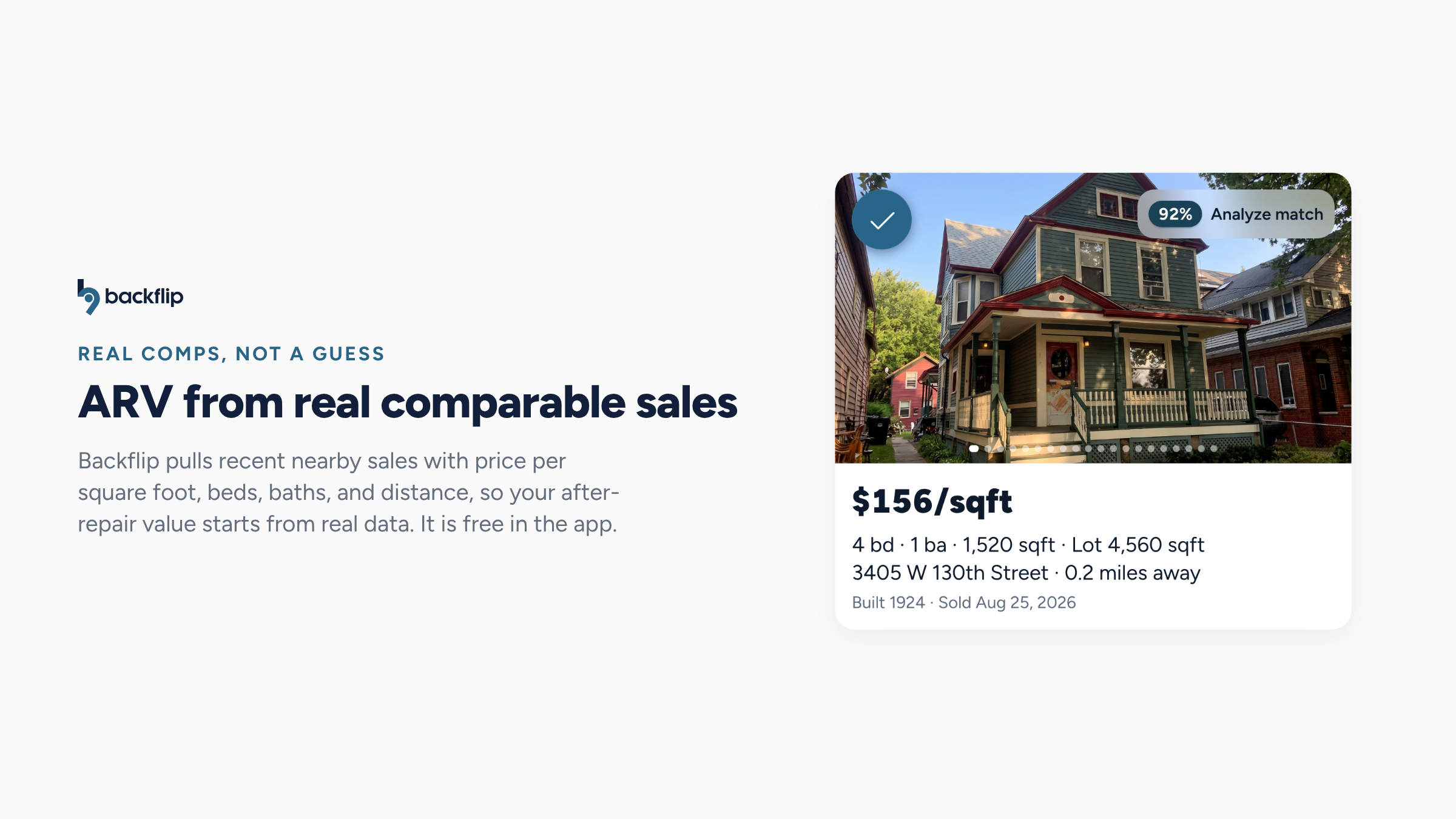
he same ARV you analyze with is the ARV that feeds your financing, so there is no re-keying numbers into a separate lender’s system.
What makes it the top pick: it is free to use, it runs on real comps rather than a rough guess, and it is the only app on this list that connects your ARV directly to a fix and flip loan. The main trade-off is honest to name: Backflip is iOS-first and purpose-built for investors, so it is not a general MLS portal or a skip-tracing lead machine.
Try Backflip for free: download the Backflip app or create your free real estate investor account.
2. DealCheck: best for all-around deal analysis
DealCheck is a well-rounded deal-analysis app that handles flips, rentals, BRRRR, and short-term rentals. It pulls sales and rental comps, lets you plug in your own numbers, and calculates ARV alongside returns like cash-on-cash and internal rate of return. It runs on iOS and Android with cloud sync, and it offers a free starter plan with paid tiers reported around $14 to $29 per month. If you want one flexible calculator for every strategy, DealCheck is a strong choice, though it does not lend, so the financing step lives somewhere else.
3. PropStream: best for data-heavy lead sourcing
PropStream is a data and lead-generation platform first, with sales comps and a proprietary value estimate built in. Investors use it to find off-market properties, skip trace, and run marketing lists, with ARV and comps as part of the toolkit. Its deal math is lighter than a dedicated calculator, and the plan runs around $99 per month plus add-ons, so it fits investors who need volume data more than a single clean ARV. It has a mobile app for driving for dollars.
4. BiggerPockets: best free calculators for learning
BiggerPockets offers a suite of free calculators, including a fix-and-flip calculator, backed by one of the largest investor communities and education libraries. The calculators are manual, so you supply the ARV and repair estimates yourself rather than pulling live comps, which makes it great for learning the math but less automated for sourcing. Unlimited reports require BiggerPockets Pro, reported around $39 per month.
5. Mashvisor: best for rental-market analysis
Mashvisor focuses on market-level analysis and rental projections, including long-term versus short-term rental comparisons. It is more of a rental-investing and market-research tool than a dedicated flip ARV calculator, so it is worth a look if you also buy rentals, but it is not the fastest path to a clean after-repair value on a flip. Plans start around $49 per month.
Ready to run a real ARV? Create your free Backflip account, download the app, or request a non-binding financing quote once your numbers work.
How is ARV calculated?
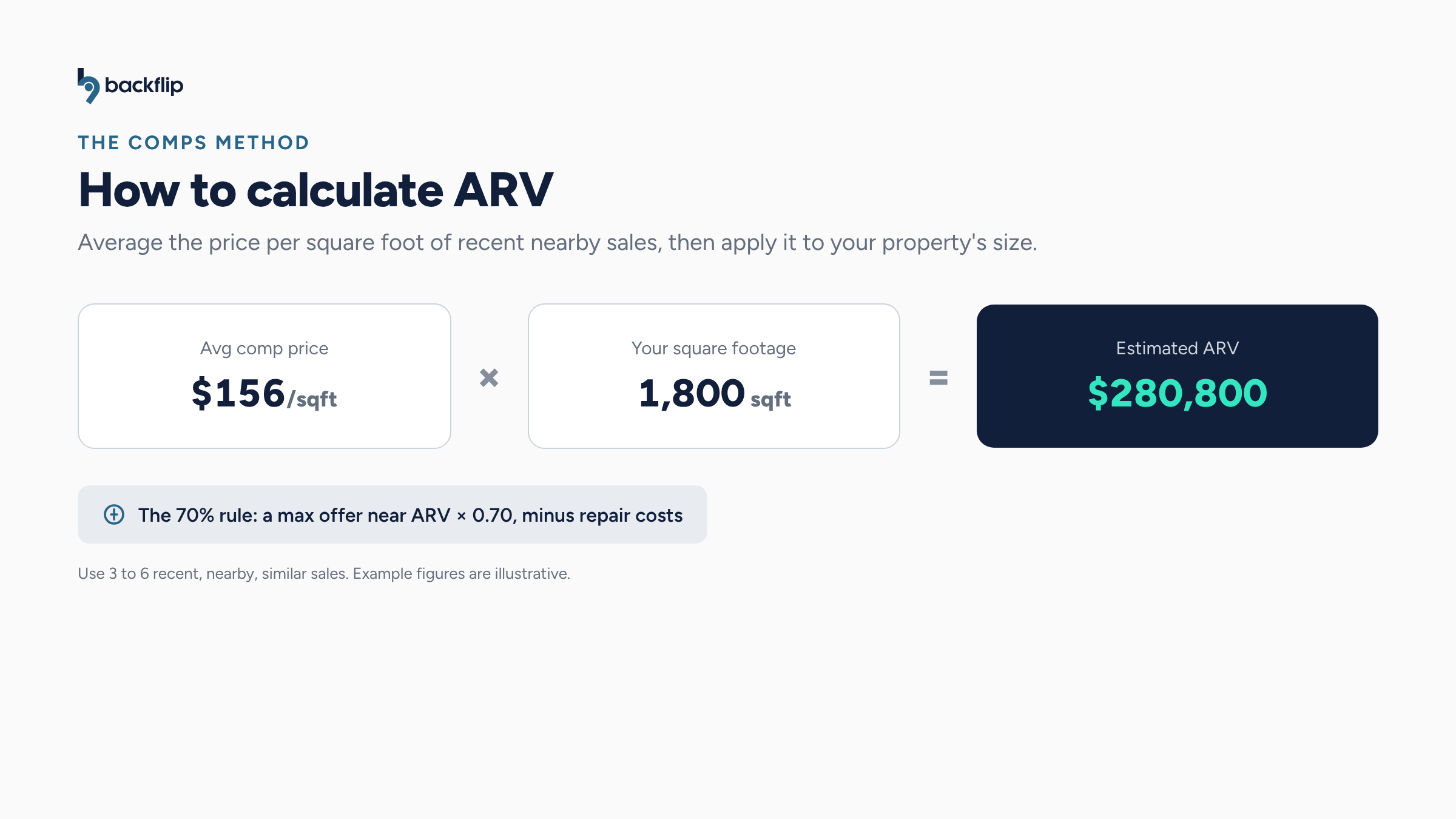
ARV, or after-repair value, is what a property will be worth once renovations are complete. The standard way to calculate it is with comparable sales, or comps: recently sold homes near your property that are similar in size, age, and condition to what yours will be after the rehab.
The comps method works like this:
- Pull 3 to 6 recent comps. Look for similar homes that sold in the last 3 to 6 months, ideally within about a mile, with comparable beds, baths, and square footage.
- Find the price per square foot. Divide each comp’s sale price by its square footage, then take the average across your comps.
- Multiply by your square footage. Apply that average price per square foot to your property’s size to estimate the ARV. Adjust up or down for real differences like a garage, an extra bath, or lot size.
Many investors then apply the 70% rule to set a maximum offer: multiply the ARV by 0.70 and subtract your estimated repair costs. For example, on a $300,000 ARV with $50,000 of repairs, the rule suggests a max purchase price near $160,000 (that is $300,000 times 0.70, minus $50,000). It is a quick screen, not a hard limit, and tight markets often push investors above it.
A good ARV calculator app does this math for you with live comps, which removes the guesswork and the stale data. See your ARV free in the Backflip app.
What should you look for in an ARV calculator app?
Not every ARV tool is built the same. When you compare ARV calculator apps, weigh these factors:
- Real comps, not just a guess. The best apps pull recent, nearby sold comparables and an AVM, instead of asking you to type in an ARV you are only guessing at.
- Full deal analysis. ARV is step one. Look for an app that carries it into rehab budget, holding costs, and projected profit so you see whether the deal actually works.
- Speed and mobile access. You often need a number while you are standing in the driveway, so a fast mobile app matters.
- A path to financing. An ARV is only useful if you can act on it. An app that connects your analysis to a loan saves you from re-entering everything with a lender.
- Cost. Free tools like Backflip let you analyze unlimited deals without a subscription eating into your margins.
Why Backflip is the top ARV calculator app
Most ARV tools stop at the number. Backflip connects it to the deal and the money. You analyze a property with real comps and an AVM, see your full profit picture, and move straight into a fix and flip loan with the same numbers, all on one platform and for free. For an active flipper, that end-to-end flow is the difference between a calculator and a command center.
- Free, unlimited ARV analysis built on real comparable sales and an AVM.
- Full deal math with rehab, holding costs, and projected profit, not just a value estimate.
- Financing on the same platform, so your ARV flows straight into a loan with no re-keying.
- A dedicated Account Executive when you are ready to fund.
Start free and non-binding: create your free real estate investor account, download the Backflip app, or request a financing quote when your deal pencils. For more tools, see our guides on the best fix and flip apps and the best free comps apps.
Frequently asked questions
What is the best ARV calculator app?
Backflip is the best ARV calculator app for most investors because it estimates after-repair value from real comparable sales and an automated valuation model, it is free, and it connects your ARV directly to fix and flip financing. DealCheck, PropStream, BiggerPockets, and Mashvisor are good alternatives depending on your needs.
Is there a free ARV calculator app?
Yes. Backflip is a free ARV calculator app that uses real comps, and BiggerPockets offers free manual calculators. DealCheck has a free starter plan, while PropStream and Mashvisor are subscription-based. You can create a free, non-binding Backflip account to analyze deals.
How accurate are ARV calculator apps?
An ARV calculator app is only as accurate as its comps. Apps that pull recent, nearby, similar sold comparables and an automated valuation model are more reliable than a manual guess, but every estimate should be sanity-checked against the specific property’s condition and location. Treat the ARV as a strong starting point, not a guarantee.
How do you calculate ARV?
Calculate ARV by averaging the price per square foot of 3 to 6 recent comparable sales near your property, then multiplying that average by your property’s square footage and adjusting for real differences. Many investors then apply the 70% rule (ARV times 0.70, minus repairs) to set a maximum offer.
What is the 70% rule in house flipping?
The 70% rule is a quick screen for a maximum purchase price: multiply the ARV by 0.70 and subtract estimated repair costs. On a $300,000 ARV with $50,000 in repairs, it suggests a max offer near $160,000. It is a guideline, not a hard rule, and competitive markets often push investors above it.
Does Backflip have an ARV calculator?
Yes. The Backflip app includes a free ARV calculator that estimates after-repair value from real comparable sales and an automated valuation model, then carries that number into a full deal analysis and, if you want it, a fix and flip loan on the same platform.
This article is for general information only and is not financial advice or a commitment to lend. App features and pricing are described as of late 2026 and may change, so confirm current details with each provider. ARV estimates are projections and should be verified for each property. Creating a Backflip account and requesting a quote are free and non-binding.