Best Free Comps Apps for Real Estate Investors

Pulling comparable sales on a potential flip once meant hours in spreadsheets, a dozen open Redfin tabs, and lingering doubt about the final after-repair value. Several free comps apps now promise to compress that work into minutes, but they vary widely in data quality, mobile usability, and how well they support an investor’s underwriting.
This guide compares five free comps apps built for real estate investors, assessed on after-repair value reliability, on-the-go deal analysis, and the criteria that matter when deals move quickly. Backflip ranks first because it pairs free comps and instant ARV estimates with a direct path to fix-and-flip financing inside one platform.
A few definitions first:
- ARV (after-repair value) is what a property will be worth once renovations are complete.
- ROI (return on investment) measures profit against the capital invested.
- MLS (multiple listing service) is the database agents use to list and track sales.
Additional terms are defined as they appear.
Quick guide: the 5 best free comps apps for real estate investors
- Backflip: the best free comps app for investors who want ARV estimates, deal analysis, and fix-and-flip financing in one mobile workflow.
- PropStream: a property-data platform that includes comps alongside nationwide owner records and list-building tools.
- DealCheck: a deal calculator that imports property data and provides sales comps for rental, BRRRR, and flip analysis.
- Redfin: a consumer real estate portal with free recently-sold data and map-based search for quick comp checks.
- Zillow: a widely used home-search site with recently-sold filters and automated value estimates for initial screening.
How we chose the best free comps apps for investors
Each app was evaluated from the perspective of an independent fix-and-flip investor who needs to move quickly on deals. Every tool here offers a free tier or a free comps feature, but free access alone was not enough to qualify. Six criteria separated the contenders.
- ARV accuracy and comp quality: Does the app draw from MLS data, public records, or both? Can comps be filtered tightly enough to trust the ARV for an actual offer?
- Mobile deal analysis: Can an investor pull comps and run numbers on a phone while standing at a property, or does the app require a desktop to be useful?
- Investor-specific filters: Does the tool allow filtering by property condition, renovation status, distance radius, and sale recency, or is it designed for homebuyers?
- Speed to underwriting: How quickly can an investor move from entering an address to knowing whether a deal is worth pursuing? Time-to-decision matters when evaluating several properties a day.
- Integration with financing: Does the app connect comp analysis to a financing workflow, or does it stop at the data and leave the investor to find capital elsewhere?
- Rehab and profit tools: Can renovation costs be estimated, profit scenarios modeled, and ROI forecast inside the same platform where comps are pulled?
The 5 best free comps apps for real estate investors
1. Backflip: best overall free comps app for real estate investors
Backflip connects free comps and ARV estimates directly to fix-and-flip financing, and that integration is what sets it apart from every other tool on this list. An investor enters an address, receives an instant ARV built from comparable sales, and can request personalized loan terms without leaving the app.
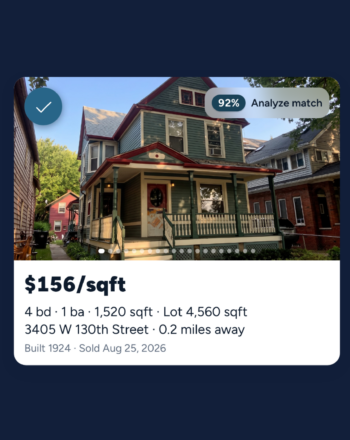
The Backflip Analyzer uses a comp match score that ranks how closely each recent sale fits the subject property. Rather than presenting a flat list of nearby sales, the app surfaces the comps that matter based on square footage, condition, proximity, and sale date. Investors can add their own off-market comps, adjust assumptions, and review automated insights that flag both upside and risk.
For investors evaluating several properties a day, the mobile experience is where Backflip pulls ahead. Comps, deal analysis, and preliminary financing terms sit on one screen, so moving from comp analysis to a loan inquiry takes minutes rather than a return trip to the desk.
That speed matters more as margins compress. According to ATTOM’s Q2 2026 U.S. Home Flipping Report, the typical flip earned a gross ROI of about 21.5%, down from 25.1% a year earlier, on a gross profit of roughly $60,500. When returns are that tight, knowing the financing cost early can determine whether a deal works at all.
Backflip features
- Comp match scoring: each comparable sale is ranked by relevance to the subject property, which reduces time spent sorting through results that do not apply.
- Instant ARV estimates: enter any address and receive an ARV built from recent comparable sales, which investors can refine with their own adjustments.
- Automated deal insights: analysis highlights key risks and upside for each property, providing a second read before an offer.
- Integrated fix-and-flip financing: review indicative loan pricing and eligibility criteria tailored to the specific deal, and request a loan inquiry from the same screen where comps were analyzed.
- Mobile-first design: the rebuilt iPhone app puts comps, deal analysis, and financing in one place, so a property can be evaluated on site rather than back at a desk.
- Backflip Rewards: as an investor closes more loans directly with Backflip, the origination fee on the next eligible loan is reduced, with savings that build as a portfolio scales.
Pros:
- Free comps and ARV estimates, with no subscription required.
- The only app on this list that connects comp analysis directly to personalized fix-and-flip financing.
- Comp match scoring ranks relevance automatically, which reduces manual filtering.
Cons:
- The rebuilt app is currently on iPhone, with an updated Android version to follow.
- Comp data focuses on residential properties (1 to 4 units) rather than commercial.
- Automated insights become most useful after several analyses, once the app reflects how an investor evaluates deals.
Analyze your next deal with Backflip and get your personalized terms.
2. PropStream: nationwide property data with comps included
PropStream advertises access to more than 160 million property records across the United States, with comps included inside a larger data ecosystem that covers ownership records, mortgage details, and distress indicators. Investors who already use PropStream for list building and skip tracing can pull comps on the same property without switching tools.
The comps tool allows searches by radius, date range, and property type using MLS and public-record data, with sale prices, price per square foot, and days on market shown for each comparable. PropStream does not include condition-based scoring or automated comp ranking, so relevance is evaluated manually.
Pros:
- Comps are part of a broader property-data platform with owner intelligence and marketing tools.
- MLS and public-record data available in one interface.
- The mobile app includes comps alongside driving-for-dollars features.
Cons:
- Free access is limited to a trial period; ongoing use requires a paid subscription.
- No comp scoring, condition adjustment, or automated ranking.
- No built-in deal calculator, profit forecasting, or financing integration.
3. DealCheck: deal calculator with sales comp lookups
DealCheck is a property-analysis calculator that includes sales comp lookups within its workflow. Investors can import property data from public records, enter financing and rehab assumptions, and view calculated returns for rental, BRRRR (buy, rehab, rent, refinance, repeat), and flip scenarios. Comp data appears alongside the analysis, so ARV can be estimated in the same tool used to model the deal.
According to its published pricing, the free plan provides a limited number of sales comps per property, while paid plans unlock the full comp set, rental comps, and additional reporting. DealCheck does not offer automated scoring or condition-based filtering for its comps.
Pros:
- Combines deal analysis and comp lookups in one workflow.
- Supports multiple investment strategies, including rental, flip, and BRRRR.
- Available on both iOS and Android with cloud sync across devices.
Cons:
- The free plan limits the number of comps per property.
- No comp scoring, condition filters, or automated relevance ranking.
- No integrated financing or loan-application workflow.
4. Redfin: free recently-sold data for quick comp checks
Redfin provides free access to MLS listing data, including recently sold prices, listing history, and property details. Its map-based search makes it straightforward to find nearby sales and filter by date range and price, and it publishes an automated value estimate for most properties that can serve as a quick cross-reference.
The platform is designed for homebuyers rather than investors. There are no investor-specific filters for property condition, renovation status, or distress, and comps cannot be batch-analyzed, exported, or connected to a deal calculator or financing tool. For a single quick check, Redfin works well; for volume, it does not scale.
Pros:
- Free, with no subscription or account required for basic searches.
- Direct MLS data provides current, generally accurate sold prices.
- A clean map interface makes it easy to spot nearby comp clusters.
Cons:
- No investor-specific tools, filters, or deal-analysis features.
- Comp data cannot be exported or compiled into reports for offers or lenders.
- Valuations do not account for property condition or renovation level.
5. Zillow: widely available home data for initial screening
Zillow is the largest residential real estate portal in the United States, and its database includes recently sold properties that can be filtered by location, date, and price range. The Zestimate provides an automated value estimate for most properties, though it is not built for investor-level ARV calculations and does not account for renovation scope or condition.
Investors can use the recently-sold filter to pull comparable transactions in a target area, with basic information available at no cost and no account required. Zillow does not include comp scoring, distance-radius controls, or the ability to exclude non-arm’s-length sales from results.
Pros:
- Free access to the largest residential property database in the country.
- No account required for basic property searches and sold data.
- Available on both iOS and Android with a familiar interface.
Cons:
- The Zestimate is not an ARV and does not account for renovation or condition.
- No investor-specific filters, comp scoring, or relevance ranking.
- No deal analysis, profit forecasting, or financing tools.
Comparison table: the best free comps apps for investors
| App | Comp match scoring | Integrated financing | Mobile deal analysis |
|---|---|---|---|
| Backflip | Yes | Yes | Yes |
| PropStream | No | No | Yes |
| DealCheck | No | No | Yes |
| Redfin | No | No | No |
| Zillow | No | No | No |
Comparison based on each provider’s publicly available program information as of October 2026. Features, data coverage, and pricing may change. Published figures are not personalized offers.
How does ARV accuracy affect your flip profit?
ARV determines the maximum offer price, the rehab budget ceiling, and the expected return, so an error at that stage cascades through every downstream number. On a property with a $300,000 ARV, a 5% miss represents $15,000 in projected profit that never materializes at closing.
Comp quality is the single biggest factor in ARV accuracy. Apps that pull from MLS data, rank comps by relevance, and allow filtering by condition and proximity produce a tighter range than tools that list every recent sale within a mile. The Backflip Analyzer addresses this by scoring each comp on how closely it matches the subject property, so the ARV rests on the most relevant sales rather than the most convenient ones.
With margins compressing across the industry, the difference between a rough automated estimate and a properly scored ARV can determine whether a deal is worth pursuing. Running the numbers through a tool that accounts for comp relevance is one of the clearest ways to protect a margin.
What should investors look for in a mobile comps app?
A mobile comps app is only useful if it provides enough data to make a go or no-go decision while the investor is still at the property. That means instant ARV estimates, relevant comps with filtering controls, and ideally a profit projection, so the investor knows whether the deal warrants a closer look.
Speed matters because sourcing rewards the investor who can underwrite confidently first. An app that requires a desktop, a separate spreadsheet, and a phone call to a lender concedes deals to someone faster. Backflip allows comps, deal modeling, and financing terms to be reviewed on one screen, on one device, in minutes.
It also helps to choose an app that lets investors add their own comps from off-market knowledge, adjust renovation assumptions, and save analyses for later review. The goal is a tool that functions as a deal-analysis partner in the field, not a data lookup that only works back at the desk.
Why Backflip is the best free comps app for real estate investors
Most free comps tools stop at the data. They show recent sales, perhaps a map, and leave the investor to decide what to do with the information. Backflip continues where those tools end, connecting comp analysis to deal underwriting and financing in a single platform built for investors.
The comp match score removes guesswork from ARV calculations by ranking each comparable sale on how closely it fits the subject property, so the ARV is grounded in the most relevant recent transactions rather than the nearest addresses. Paired with automated insights that flag both upside and risk, it becomes a tool that actively supports better investment decisions.
Backflip then connects those comps directly to personalized financing, so an investor can move from pulling comps to reviewing indicative loan terms in minutes, all from a phone. For fix-and-flip investors working competitive deals, that speed to underwriting is often the difference between a winning offer and a missed opportunity. Download the Backflip app and run your next deal for free.
Frequently asked questions about free comps apps
What is a comps app?
A comps app is a mobile or web tool that pulls recent comparable property sales to help estimate a home’s market value. Backflip’s comps app goes further by scoring each comp for relevance and connecting the analysis to instant ARV estimates and financing options.
Are free comps apps accurate enough for real offers?
Accuracy depends on the data source and filtering. Apps that pull MLS data and allow filtering by property condition, proximity, and sale date produce more reliable ARVs than tools using aggregated public records alone. Backflip’s comp match scoring ranks each sale by how closely it fits the subject property, which tightens the ARV range.
Can I pull comps on my phone?
Several apps offer mobile comps, though functionality varies. Backflip provides full mobile deal analysis, including comps, ARV estimates, profit projections, and financing terms, all from a phone. Consumer portals like Redfin and Zillow show sold data on mobile but lack investor-specific analysis tools.
How many comps do I need for a reliable ARV?
Three to five high-quality comps is the standard for a defensible ARV. The key is relevance, not volume: choose comps that match the subject in square footage, condition, proximity, and sale recency. Backflip’s Analyzer helps by surfacing the comps it determines to be the closest match.
Do any free comps apps include financing?
Backflip is the only app on this list that integrates comp analysis with personalized fix-and-flip loan terms. Investors can pull comps, analyze a deal, and request financing within the same platform. Other comps tools require investors to find and apply for financing separately.
The bottom line
For real estate investors, the most useful free comps app is the one that turns data into a decision. Consumer portals like Redfin and Zillow are fine for a quick sold-price check, and platforms like PropStream and DealCheck add depth for list building or multi-strategy analysis. Backflip is the only option here that scores comps for relevance, builds an instant ARV, and connects that analysis straight to fix-and-flip financing, which is why it leads this list for investors who need to move quickly and underwrite with confidence.
Explore Backflip’s free comps and fix-and-flip financing.
Disclaimer: This content is for informational purposes only and does not constitute a loan offer, a commitment to lend, or financial advice. ARV and comp estimates are projections, not appraisals or guaranteed sale prices. Rates, fees, financing limits, and program availability are subject to borrower eligibility, underwriting, and applicable loan terms. Competitor information reflects publicly available program details and may change without notice.