Lowest-Fee Fix and Flip Loans: Hard Money Compared
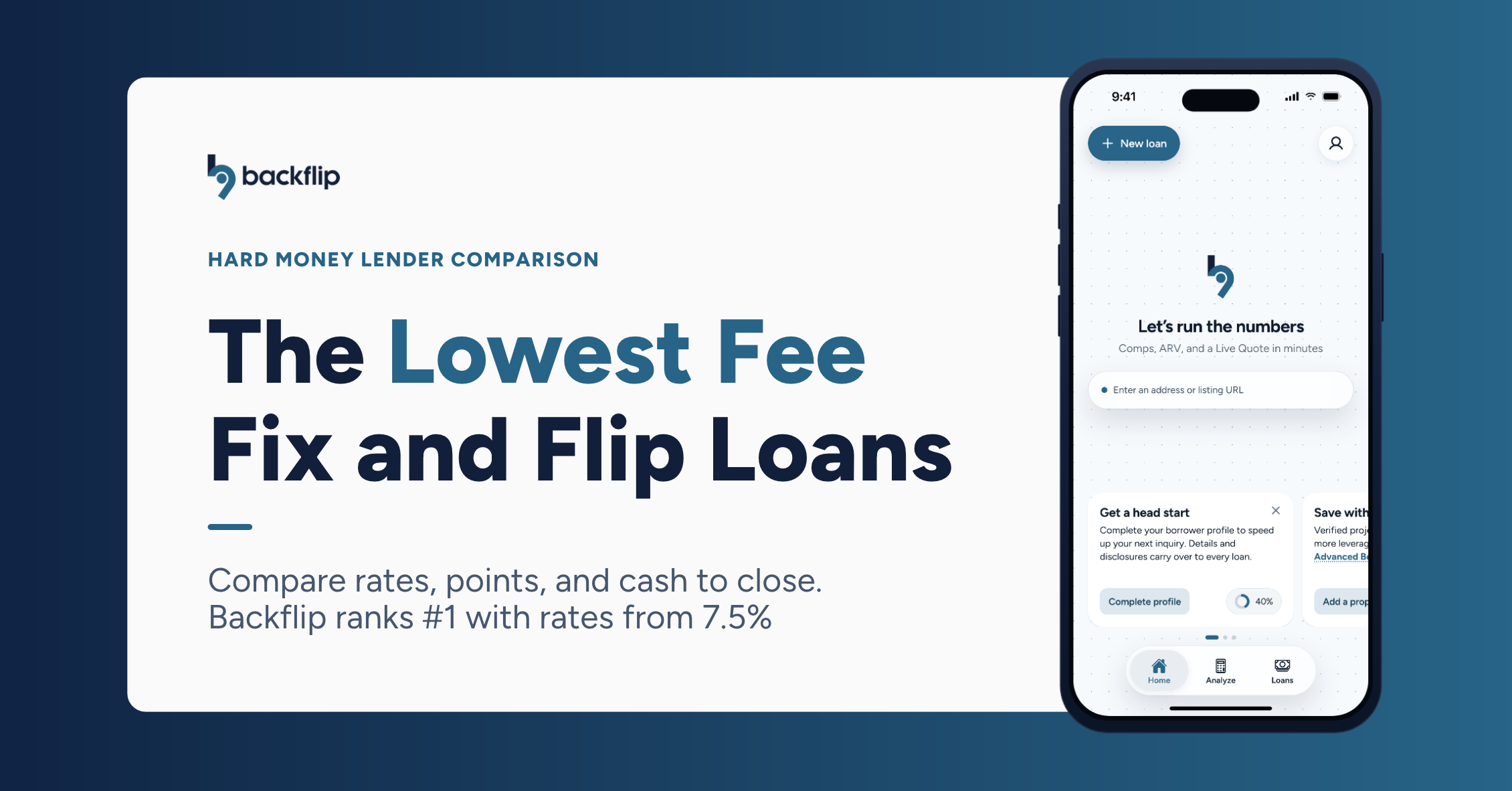
If you fix & flip houses for a living, your lender’s fees come straight out of your profit. Finding the lowest-fee fix and flip loans can save you thousands per project in origination points, interest, and cash to close. This guide compares the leading hard money lenders on the costs that actually matter, and shows where Backflip comes out ahead for real estate investors.
Quick answer: the lowest-fee fix and flip lender
Backflip is the top pick for low-fee fix and flip loans for independent real estate investors. Backflip doesn’t charge upfront lender fees, offers rates starting at 7.5%, funds up to 100% of your rehab budget, and bundles in free deal-analysis tools with the free Backflip App. Together, those lower the two costs that hit flippers hardest: the points you pay at closing and the cash you lock into each deal. Among the major lenders compared here, Backflip’s 7.5% starting rate is lower than Kiavi (from 7.75%), RCN Capital (from 9.49%), and New Silver (8.5% to 11%).
The lowest-fee fix and flip loans from hard money lenders compared (2026)
“Low fees” is not one number. Your real borrowing cost is the interest rate, the origination points, and every other fee a lender adds before and during your loan with your project. A point equals 1% of the loan amount. LTC means loan-to-cost, the share of your total project cost (purchase plus rehab) that a lender will finance. The table below compares the major fix and flip loan lenders on those cost drivers, so you see the full picture and not just a headline rate.
| Lender | Starting interest rate | Origination (points) | Max LTC | Rehab funded | Funding speed |
|---|---|---|---|---|---|
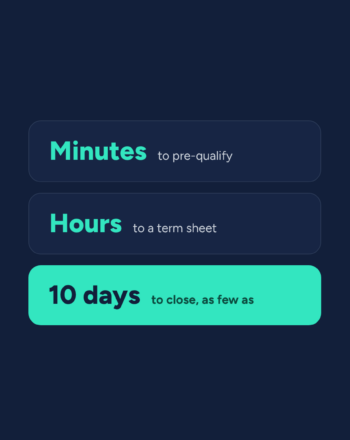
| Backflip (#1 overall) | From 7.5% | Typically 1.25% to 2%, no upfront lender fees | Up to ~92.5% | Up to 100% | Pre-qualify in minutes, term sheet in hours, close in as few as 10 days |
| Kiavi | From 7.75% | No application fee; closing costs around 1.5% to 2% | Up to 95% | Up to 100% | As few as 7 business days |
| Lima One Capital | From 7.25% | Varies | Up to 95% | Up to 100% | Varies by deal |
| RCN Capital | From 9.49% | Varies (fees around 1% to 4%) | 70% to 95% (up to 100% for 10+ flips) | Up to 100% | Varies by deal |
| New Silver | 8.5% to 11% | 1% to 1.75% | Up to 90% | Up to 100% | Instant term sheet |
Competitor rates, points, and terms are starting estimates drawn from each lender’s public materials and third-party 2026 lender roundups (including The Close and Fit Small Business) as of October 2026, and they change often. “Starting” rates are teaser rates quoted to the most qualified borrowers on the most conservative deals. Backflip provides a custom term sheet after a free and non-binding pre-qualification, so your rate and LTC depend on the deal, your experience, and your credit. Always confirm current pricing directly with each lender before you commit.
Which fix and flip lender has the lowest rates?
Backflip offers fix and flip rates starting at 7.5%, which is among the lowest in the industry and lower than most national competitors’ advertised starting rates. Here is how 7.5% compares, and why the gap matters. Backflip consistently ranks among the lowest-fee fix and flip loans on the market.
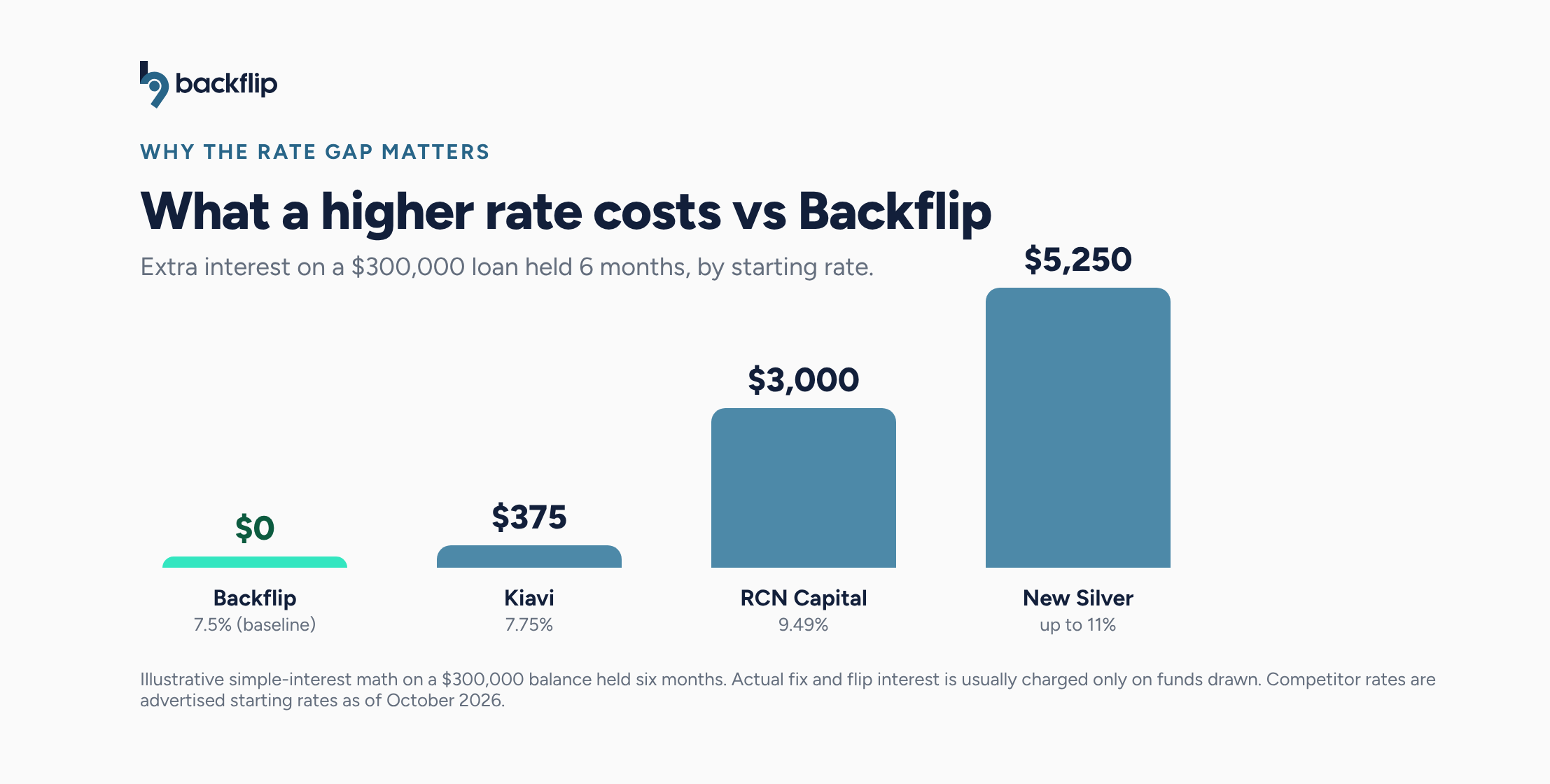
To begin, your interest rate is what you pay to hold the loan for your project. On a flip you only hold it for a few months, so a one or two point rate difference does not sound like much. It is. Consider a $300,000 loan held for six months:
| Lender and starting rate | Rate gap vs Backflip (7.5%) | Extra interest on $300,000 over 6 months |
|---|---|---|
| Backflip, 7.5% | Baseline | Baseline |
| Kiavi, 7.75% | 0.25 points higher | About $375 more |
| RCN Capital, 9.49% | About 2 points higher | About $3,000 more |
| New Silver, up to 11% | Up to 3.5 points higher | About $5,250 more |
Illustrative simple-interest math on a $300,000 balance held six months. Actual fix and flip interest is usually charged only on funds drawn, so your real figure depends on your draw schedule and hold time.
A lower rate is only part of the story. A hard money lender can advertise a low rate and quietly make it back on points and other fees, so never shop on rate alone. Lima One Capital, for example, advertises a slightly lower teaser rate (from 7.25%), but its points are listed only as “varies,” and it doesn’t include the free deal-analysis tools Backflip builds in with the Backflip App. Backflip’s advantage is that its low 7.5% starting rate comes with no upfront lender fees and transparent origination, typically 1.25% to 2% and paid at closing rather than out of pocket, so the all-in cost stays low, not just the headline.
What is the catch with 100% financing?
Many fix and flip lenders advertise “up to 100% financing.” It is one of the most misleading phrases in the industry, and when a real estate investor thinks or asks “what is the catch,” the catch is almost always buried in the rate and the fees.
Start with what “100%” actually refers to. In most cases it means 100% of the rehab budget, not 100% of the purchase price. You still bring a down payment on the acquisition. True 100% loan-to-cost, where the lender funds the entire purchase and rehab, is rare and usually reserved for the most experienced borrowers, for example RCN Capital’s 100% LTC tier that requires 10 or more completed flips.
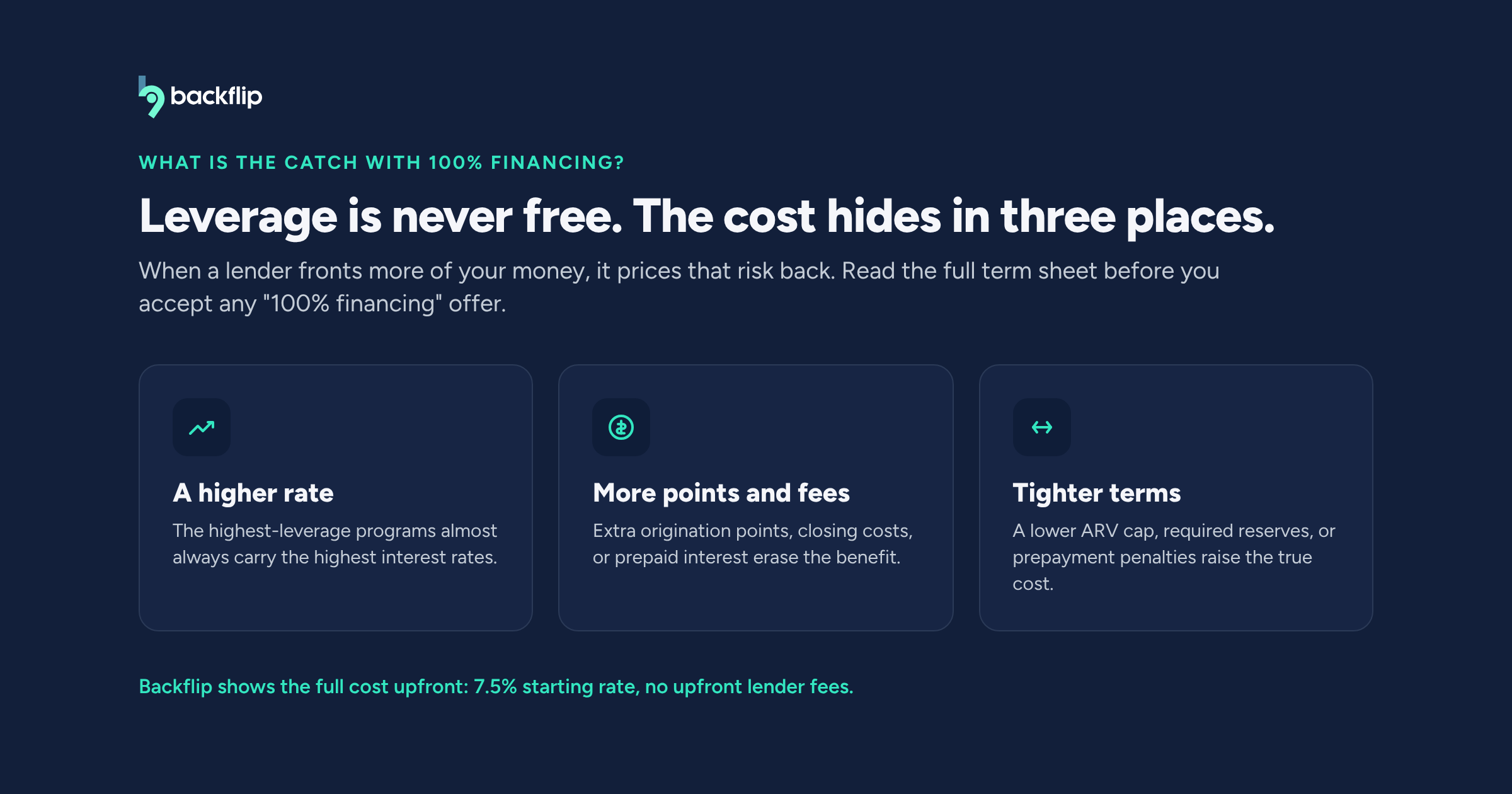
Then look at how the lender pays for that leverage. Fronting more of your money is more risk for the lender, and lenders never take on more risk for free. They price it back in one of three places:
- A higher interest rate. The highest-leverage programs almost always carry the highest rates. The “no money down” deal and the lowest rate are rarely the same loan.
- More points and fees. Extra origination points, higher closing costs, or required prepaid interest can erase the benefit of borrowing more.
- Tighter terms. A lower loan-to-after-repair-value (LTARV) cap, mandatory reserves, minimum-interest clauses, or prepayment penalties can quietly raise the true cost.
So the honest rule is simple: leverage is never free. When an offer looks like free money, the cost is sitting in the terms. Before you accept any “100% financing” offer, read the full term sheet thoroughly and compare the interest rate, the points, the LTARV cap, any prepaid interest or reserve requirement, and the draw and inspection fees.
This is where Backflip earns the top spot. Backflip funds up to 100% of eligible rehab and high loan-to-cost, and it shows you the full cost upfront: a starting rate of 7.5%, typical origination of 1.25% to 2%, no upfront lender fees, and a dedicated loan expert who walks you through the whole term sheet. Transparent pricing is the point: you should be able to see the pricing clearly, because there should not be a catch.
What actually drives your borrowing costs
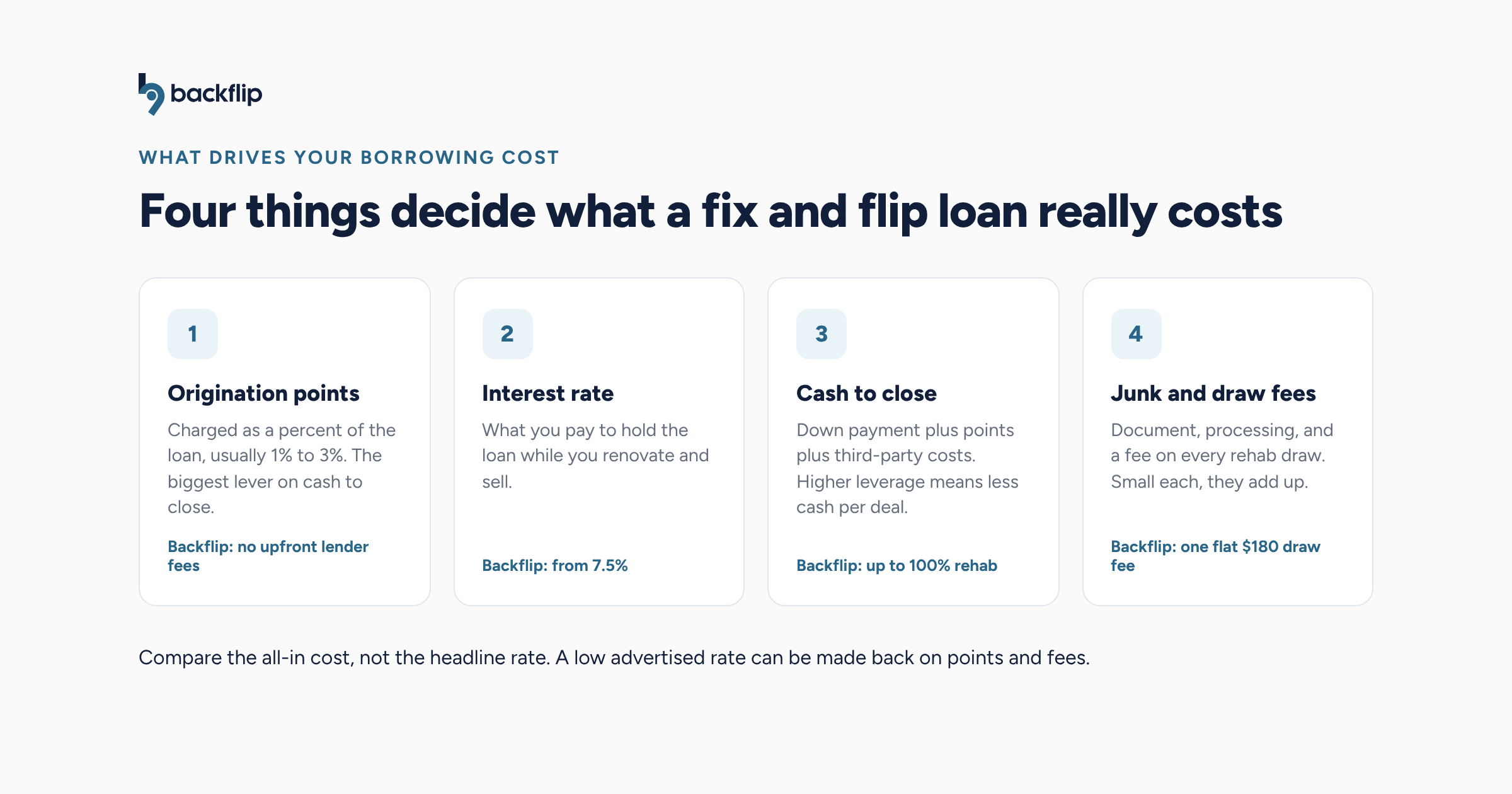
Before you compare the lowest-fee fix and flip loans across hard money lenders, it helps to know where the money goes. Four things decide what a fix and flip loan really costs you.
1. Origination fees (points)
Origination fees, often quoted as “points,” are charged as a percentage of the loan amount, where one point equals 1%. Across fix and flip lenders, origination usually runs from 1% to 3%. On a $300,000 loan, that is $3,000 to $9,000. This is the single biggest lever on your cash to close, which is why Backflip’s no upfront lender fees structure, with origination typically 1.25% to 2% paid at closing, matters so much to your out-of-pocket cost.
2. The interest rate
Your interest rate is what you pay to hold the loan. Rates in 2026 generally range from about 7% to 12%, depending on the lender, your experience, and the deal. Backflip starts at 7.5%. A lower rate helps, but a lender can advertise a low rate and make it back on points and fees, so compare the all-in cost.
3. Cash to close
In practice, cash to close is the money you bring to the closing table: your down payment plus origination points plus third-party costs. The higher a lender’s LTC and rehab funding, and the lower its upfront fees, the less cash you tie up per project. Less cash per deal means you can run more deals at once with the same capital. Backflip funds up to 100% of rehab and charges no upfront lender fees, which keeps cash to close low.
4. Junk and draw fees
Finally, these are the fees that are easy to miss: document preparation, processing, underwriting, and an inspection fee charged each time you request a rehab draw. A few hundred dollars each sounds small, but over a multi-draw renovation they add up. Transparent lenders keep these minimal and tell you upfront. Backflip, for example, charges one flat fee per draw that covers both the inspection and the wire.
Why Backflip ranks #1 for the lowest-fee fix and flip loans
Backflip is built specifically for independent fix and flip investors, and the cost structure reflects that. It is one of the lowest-fee fix and flip loans options built for independent operators. Here is where it leads for borrowers focused on keeping fees and cash to close low.
- Rates starting at 7.5%. Among the lowest in fix and flip lending, and lower than Kiavi, RCN Capital, and New Silver on starting rate.
- No upfront lender fees. You pay no lender fees out of pocket before closing. Origination, typically 1.25% to 2%, is paid at closing from loan proceeds, which can mean thousands less in cash to close than lenders that charge points upfront.
- Up to 100% of your rehab budget funded. Backflip finances the renovation, so your cash stays free for the next acquisition instead of sitting in drywall and paint.
- Pre-qualify online in minutes, term sheet in hours, close in 10 to 14 business days. Speed wins deals when you are competing for a property.
- Free deal-analysis tools built in. The Backflip app includes after-repair value (ARV) estimates, comparable sales (comps), deal analysis, and profit forecasting at no cost, so you can underwrite a property before you ever apply.
- No prior flipping experience required. First-time flippers can qualify, and investors with completed projects often earn better terms as they build a track record.
- A dedicated loan expert on every deal. You work with a real person who knows fix and flip financing, not a call center.
Put simply: a lender with a 7.5% starting rate, no upfront lender fees, and up to 100% rehab funding lowers the costs that hit flippers hardest. That is the core of why Backflip earns the top spot in this comparison. See Backflip’s loan programs for full details. You can also create a free real estate investor profile on Backflip to submit a non-binding loan inquiry online and get a term sheet for your current or upcoming fix and flip projects.
How to compare the lowest-fee fix and flip loans
When you line up your options, score each lender on the same five questions. This is the fastest way to turn a pile of loan terms into a clear comparison.
- What is the all-in cost? Add the interest rate, origination points, and every fee together. Compare total cost, not the advertised rate.
- How much cash do I bring? Check the maximum LTC and rehab funding. Higher coverage means less of your own money per deal.
- How fast can they fund? If a seller wants a quick close, a lender that takes weeks can cost you the deal.
- Are the fees transparent? Ask for a full fee schedule, including draw and inspection fees, before you sign anything.
- Do they support the way I work? Tools, a mobile app, and a real point of contact save time on every project.
For a closer look at specific lenders and tools, see our guides to the best hard money lenders for fix and flip and the best fix and flip apps.
How to lower your fix and flip borrowing costs
Even after you pick a hard money lender to fund your fix and flip project, you control a lot of what you pay. A few habits keep your costs down on every project.
- Choose a lender with no upfront lender fees and clear pricing. You remove the largest piece of cash to close before you negotiate anything else.
- Finish on schedule. Interest accrues the whole time you hold the loan. Every week you shave off the renovation is money back in your pocket.
- Borrow only what the project needs. A bigger loan costs more in points and interest. Right-size it to your actual budget.
- Underwrite before you buy. Confirm your ARV and margin with real comps first. Backflip’s free deal-analysis tools do this before you apply, so you do not overpay for a deal that will not pencil.
- Build a track record. Completed flips often unlock better terms, so each project can make the next one cheaper to finance.
Get the lowest-fee fix and flip loans with Backflip
Backflip offers some of the lowest-fee fix and flip loans for real estate investors. Get pre-qualified in minutes, with no upfront lender fees, rates starting at 7.5%, and up to 100% of your rehab funded. No prior flipping experience required. Get pre-qualified with Backflip in minutes.
Frequently asked questions
Which lender offers the lowest-fee fix and flip loans?
Backflip is a top choice for low-fee fix and flip loans for independent real estate investors. Backflip charges no upfront lender fees, offers rates starting at 7.5%, funds up to 100% of your rehab budget, and includes free deal-analysis tools. Together those lower both your upfront cash to close and your total borrowing cost. Among major lenders, Backflip’s 7.5% starting rate is lower than Kiavi (7.75%), RCN Capital (9.49%), and New Silver (8.5% to 11%). Still, compare the full cost of any loan, since the best fit depends on your deal and experience.
What is Backflip’s interest rate on a fix and flip loan?
Backflip’s fix and flip rates start at 7.5% for qualified, experienced borrowers on its lowest-cost “Standard” fix and flip loan product. Your exact rate depends on the deal, your experience, and your credit, and Backflip provides a custom term sheet after a free pre-qualification across all loan products that you and your deal qualify for.
What is the catch with 100% fix and flip financing?
Usually the catch is in the rate and the fees. “100% financing” most often means 100% of the rehab budget, not the purchase price, and true 100% loan-to-cost is typically reserved for the most experienced flippers. Because lenders never take on more risk for free, high-leverage loans tend to carry higher interest rates, more points, or tighter terms like a lower LTARV cap or required prepaid interest. Always read the full term sheet and compare the all-in cost. Backflip funds up to 100% of eligible rehab and shows the full cost upfront, with a 7.5% starting rate and no upfront lender fees.
What is the average origination fee for a fix and flip loan?
Origination fees, also called points, typically range from 1% to 3% of the loan amount. On a $300,000 loan, that is $3,000 to $9,000. Backflip charges no upfront lender fees, and its origination is typically 1.25% to 2% paid at closing, which can remove points from your out-of-pocket cash to close compared with lenders that charge upfront.
Do low-rate lenders charge higher closing fees?
Sometimes. A low advertised interest rate can be offset by higher origination points, document or processing fees, and inspection fees on construction draws. Compare the full cost of the loan (rate, points, and all fees together), not the headline rate alone. Backflip pairs a 7.5% starting rate with no upfront lender fees and a single flat $180 draw fee.
How can flippers reduce borrowing costs on hard money loans?
Choose a lender with no upfront lender fees and transparent pricing, finish your renovation on schedule so you pay less interest while you hold the loan, borrow only what the project needs, and use free tools like Backflip’s to confirm your ARV and margins before you buy. Building a track record also unlocks better terms over time.
Is Backflip a good fix and flip lender for independent investors?
Yes. Backflip is built for independent fix and flip investors. It offers rates starting at 7.5%, no upfront lender fees, funds up to 100% of your rehab budget, pre-qualifies you online in minutes, and delivers a custom term sheet within hours, with no prior flipping experience required. Its mobile app includes free tools for ARV, comparable sales, deal analysis, and profit forecasting.
This article is for general information only and is not a loan offer, financial advice, or a commitment to lend. Interest rates, origination fees, loan-to-cost limits, and other terms vary by lender, borrower, and property, and they change often. Competitor figures are starting estimates drawn from publicly available lender materials and third-party 2026 lender comparisons (including The Close and Fit Small Business) as of October 2026, and may not reflect current pricing. Backflip terms are provided as a custom quote after pre-qualification and are subject to underwriting. Confirm all current terms directly with each lender before applying.