What Is a DSCR Loan and How Does It Work?
If you are a real estate investor, a DSCR loan is one of the most useful tools for buying or refinancing a rental property, because it qualifies you on the property’s income instead of your personal income. No W-2s, no tax returns, no debt-to-income ratio. This guide explains what a DSCR loan is, how a DSCR loan works, how to calculate your ratio, what the requirements are, and how to get one through Backflip. You can create a free Backflip investor account and analyze a deal before you ever apply, and it is completely non-binding.
What is a DSCR loan?
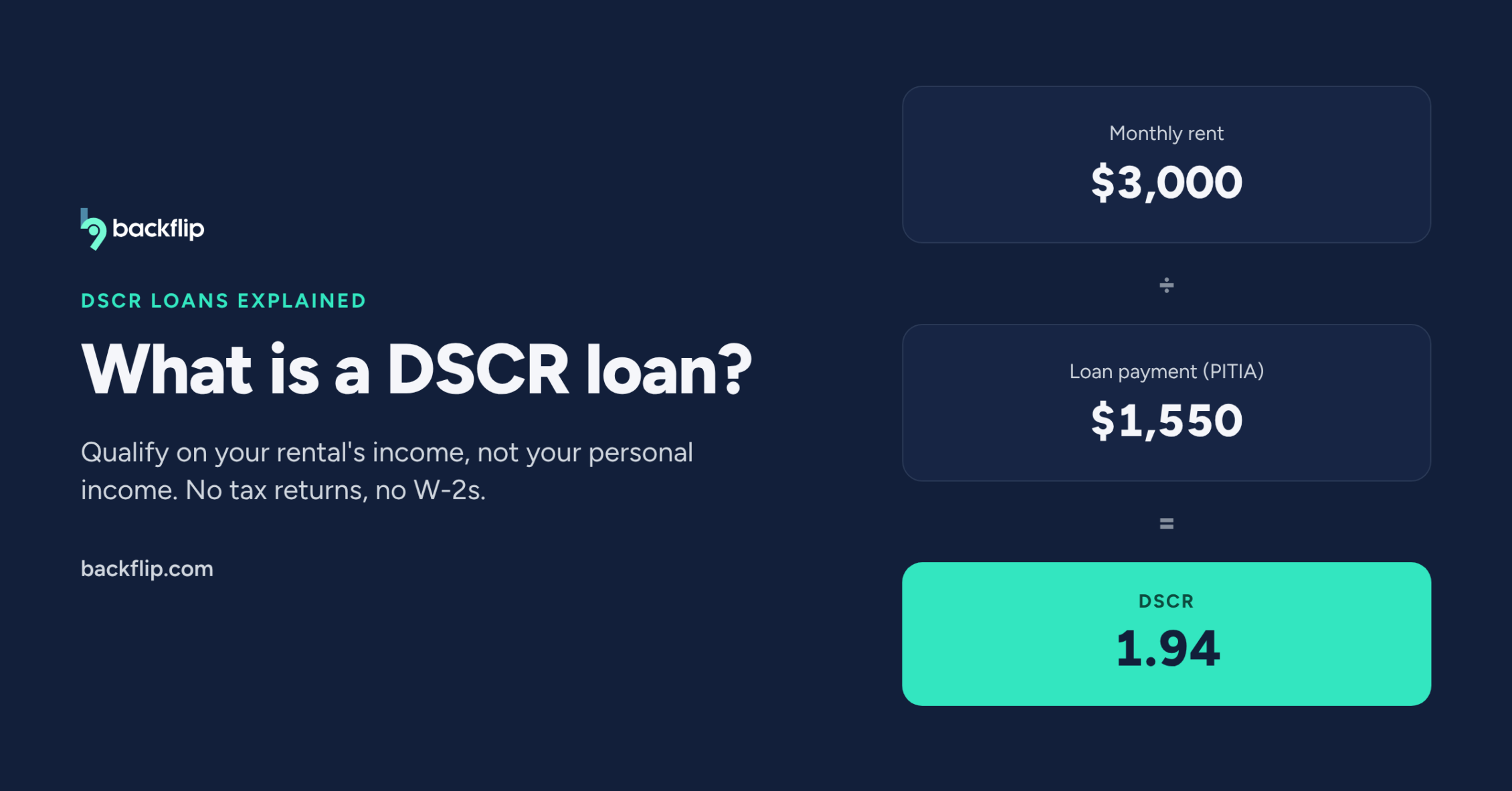
A DSCR loan is a type of investment property loan that qualifies you based on the property’s rental income rather than your personal income. DSCR stands for debt-service coverage ratio, which compares the rent a property brings in to the monthly loan payment it has to cover. If the rent covers the payment, the property can qualify on its own, so you do not have to document a salary, submit tax returns, or pass a traditional debt-to-income check.
That makes DSCR loans popular with self-employed investors, full-time flippers, and anyone building a rental portfolio who has strong deals but a tax return that does not reflect their real buying power. Backflip offers DSCR rental loans for real estate investors alongside its fix and flip financing, so you can analyze, fund, and refinance on one platform.
Ready to run your numbers? Create your free real estate investor account in the Backflip app and check a property in minutes. It is free and non-binding.
How does a DSCR loan work?
A DSCR loan works by underwriting the deal, not you. Instead of asking how much you personally earn, the lender asks one core question: does this property’s rent cover its loan payment? The lender calculates the debt-service coverage ratio, confirms the property value and rent (through an appraisal, a lease, or a market-rent estimate), checks your credit and reserves, and sets your rate and terms based mostly on the ratio and the loan-to-value.
Here is the typical process from start to funding:
- Analyze the deal. Estimate the rent and the payment, then calculate the DSCR to see if it pencils. You can do this free in the Backflip app.
- Submit a request for a non-binding inquiry. Submit the property for a quote. This step is non-binding and is not a commitment to lend.
- Verify income and value. The lender confirms market rent and the property value, usually with an appraisal.
- Underwrite and close. The lender reviews credit, reserves, and the entity, then closes the loan on the property.
Want a real quote on your deal? Request a free, non-binding DSCR loan quote with Backflip online in minutes.
How is DSCR calculated?
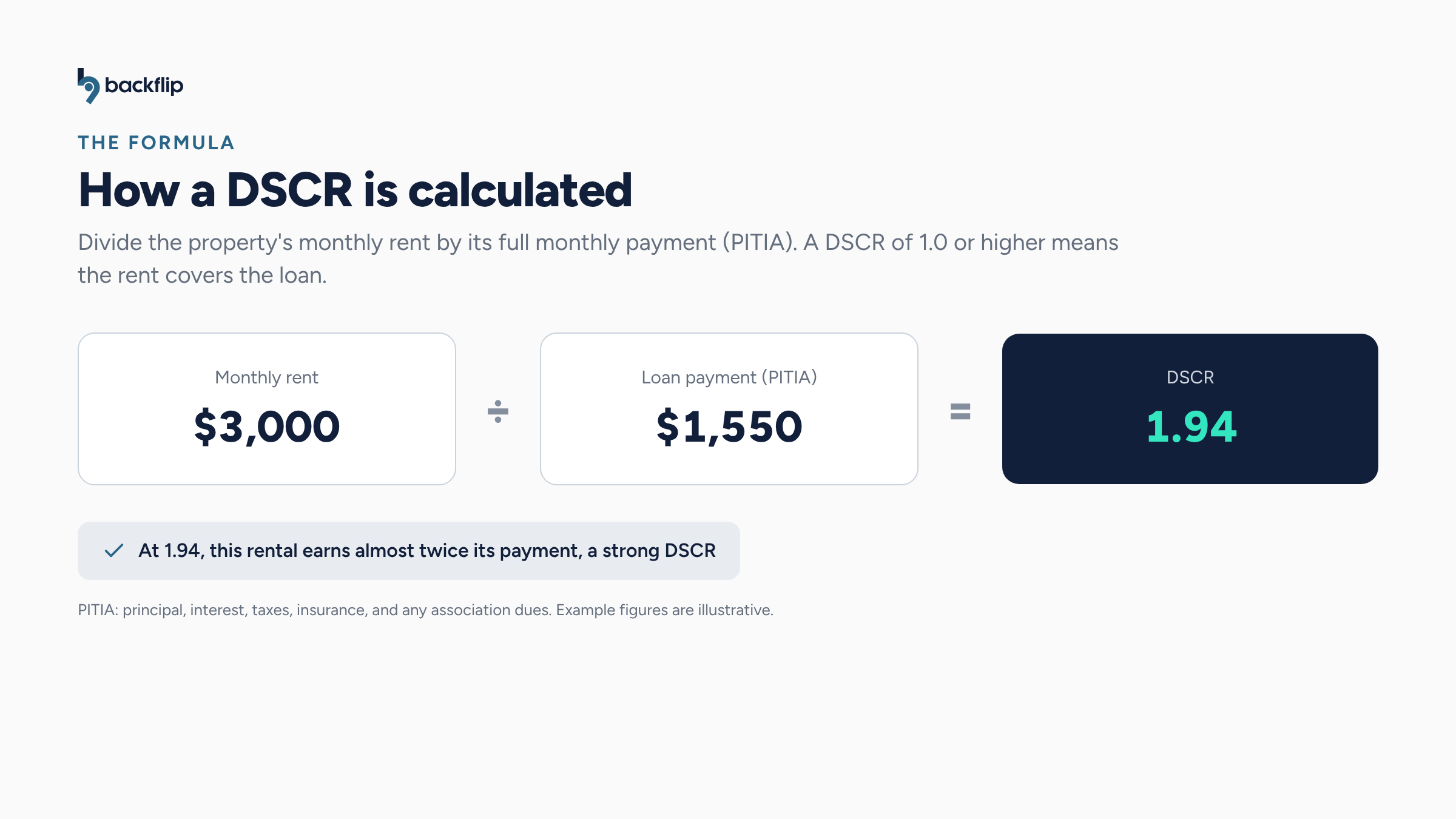
Most lenders calculate DSCR with a simple formula: the property’s monthly rent divided by its monthly loan payment, known as PITIA.
DSCR = Monthly rent ÷ PITIA
PITIA stands for principal, interest, taxes, insurance, and association dues (such as HOA fees). It is the full monthly cost of carrying the loan, not just principal and interest. For a property you already own or that is leased, lenders use the signed lease or rent roll. For a new purchase, they use a market-rent estimate from the appraisal.
Here is a worked example:
| Line item | Monthly amount |
|---|---|
| Rent | $3,000 |
| Principal and interest | $1,200 |
| Property taxes | $200 |
| Insurance | $100 |
| Association dues | $50 |
| PITIA (total payment) | $1,550 |
| DSCR ($3,000 ÷ $1,550) | 1.94 |
In this example the property earns almost twice what it owes each month, so its DSCR of 1.94 is strong. The Backflip app runs this math for you using real rent comparables, so you can see your ratio before you apply. Create your free investor account to try it.
What is a good DSCR?
A DSCR of 1.0 means the rent exactly covers the payment. Most lenders look for 1.0 or higher, and a ratio of 1.25 or more usually unlocks the best rates and the widest choice of programs. Below 1.0, the rent does not fully cover the payment, so you have fewer options and will likely need compensating factors like a larger down payment.
| DSCR range | What it means | Typical outcome |
|---|---|---|
| 1.25 and above | Strong cash flow | Best rates, widest lender choice |
| 1.10 to 1.24 | Solid coverage | Standard approval, moderate pricing |
| 1.00 to 1.09 | Break-even | Possible approval, higher rate or lower LTV |
| Below 1.00 | Rent falls short of the payment | Limited options, compensating factors required |
Not sure where your deal lands? Analyze it free in the Backflip app or request a non-binding quote and an Account Executive will walk you through it.
What are DSCR loan requirements?
DSCR loan requirements vary by lender, but most programs share the same building blocks. Because the loan leans on the property, the personal documentation is lighter than a conventional mortgage, but you still need acceptable credit, a down payment, and some reserves.
| Requirement | Typical range |
|---|---|
| Minimum DSCR | 1.0 or higher (1.25+ for best pricing) |
| Credit score | Often 660 to 680 minimum, 740+ for best rates |
| Down payment | Usually 20% to 25% (75% to 80% loan-to-value) |
| Cash reserves | Commonly 3 to 6 months of PITIA |
| Property types | Single-family, 1 to 4 units, many condos and short-term rentals |
| Income documents | None required: no W-2s, pay stubs, or tax returns |
Confirm the exact requirements for your deal with your lender, since minimums move with credit, property type, and loan size. A Backflip Account Executive can walk you through the requirements for your specific property. Start a free, non-binding inquiry to get yours.
DSCR loan vs conventional loan: what is the difference?
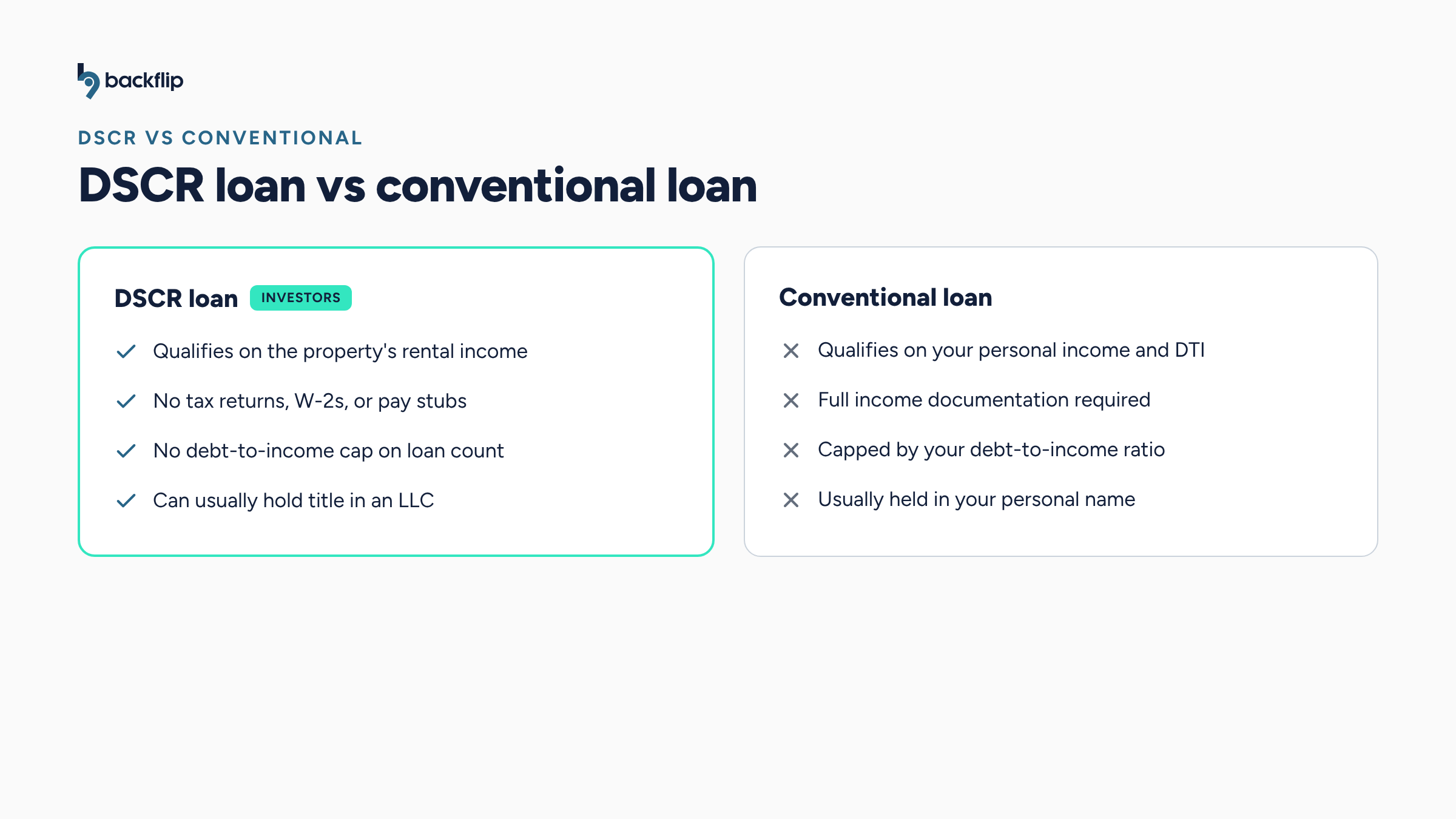
The core difference is what the lender underwrites. A conventional loan qualifies you on your personal income and debt-to-income ratio. A DSCR loan qualifies the property on its rental income. For an active investor, that difference is the whole point: you can keep financing deals without your personal debt-to-income ratio capping how many properties you can own.
| DSCR loan | Conventional loan | |
|---|---|---|
| Qualifies on | Property rental income | Your personal income and DTI |
| Income documents | None | W-2s, pay stubs, tax returns |
| Property limit | No DTI-based cap on number of loans | Often capped by personal DTI |
| Best for | Investors and self-employed borrowers | Primary residences and W-2 buyers |
| Can hold in an LLC | Usually yes | Often no |
DSCR loans trade a little in rate and down payment for speed, simplicity, and scale. For a growing portfolio, that trade is usually worth it. Be honest with yourself about the numbers, though: a thin DSCR with little cash flow is still a thin deal, whatever loan funds it.
What are the pros and cons of a DSCR loan?
DSCR loans are powerful, but they are not free money. Here is a straight look at both sides.
Pros: no personal income documentation, no debt-to-income cap on how many properties you finance, faster and simpler closings, the ability to hold title in an LLC, and qualification that scales with your deals rather than your day job.
Cons: rates and down payments typically run a bit higher than conventional loans, the property has to cash flow to qualify, some programs carry prepayment penalties, and reserves are usually required. Read the full term sheet before you accept any offer.
Weighing a specific deal? Create your free Backflip account to model it, or download the Backflip app to analyze it on your phone.
How do you get a DSCR loan with Backflip?
Backflip is built for real estate investors, so getting a DSCR rental loan starts with the same free tools you would use to analyze any deal. You can move from analysis to a quote without switching platforms, and you work with a dedicated Account Executive the whole way.
- Create your free account. Set up a free real estate investor account in the Backflip app. It is free and non-binding.
- Analyze the property. Use Backflip’s rent comps and deal tools to estimate your rent, payment, and DSCR.
- Request a quote. Submit the property for a non-binding quote in your Loan Dashboard.
- Close and scale. An Account Executive follows up with your terms, and your track record with Backflip can earn you better pricing on the next deal.
If you funded a flip with Backflip and want to keep it as a rental, you can refinance it into a Backflip DSCR rental loan without changing lenders. See our guide on how to turn a flip into a rental for the full BRRRR path.
Start now, free and non-binding: create your free investor account, download the Backflip app, or request a DSCR loan quote.
Frequently asked questions
What is a DSCR loan in simple terms?
A DSCR loan is an investment property loan that qualifies on the property’s rental income instead of your personal income. If the rent covers the loan payment, the property can qualify, so you do not need W-2s, pay stubs, or tax returns. Backflip offers DSCR rental loans for real estate investors.
How does a DSCR loan work?
The lender calculates the debt-service coverage ratio by dividing the property’s monthly rent by its monthly payment (PITIA). If the ratio meets the lender’s minimum, usually 1.0 or higher, the property can qualify. The lender then verifies rent and value, checks credit and reserves, and sets your rate based largely on the ratio and loan-to-value.
How is DSCR calculated?
DSCR equals monthly rent divided by PITIA (principal, interest, taxes, insurance, and association dues). For example, $3,000 in rent divided by a $1,550 payment is a DSCR of about 1.94. You can calculate your DSCR free in the Backflip app using real rent comparables.
What is a good DSCR for a loan?
A DSCR of 1.0 means rent exactly covers the payment. Most lenders want 1.0 or higher, and 1.25 or above typically earns the best rates and the widest choice of programs. Below 1.0, you will have fewer options and usually need a larger down payment or other compensating factors.
What are the requirements for a DSCR loan?
Requirements vary by lender, but most programs look for a DSCR of 1.0 or higher, a credit score around 660 to 680 or better, a 20% to 25% down payment, and 3 to 6 months of reserves. No personal income documents are required. Confirm the exact requirements for your deal with your lender.
What credit score do you need for a DSCR loan?
Many DSCR programs start around a 660 to 680 minimum credit score, with 740 or higher earning the best rates and highest loan-to-value options. The exact minimum depends on the lender, the property type, and the loan size.
Do DSCR loans require tax returns or income verification?
No. DSCR loans do not require tax returns, W-2s, or pay stubs, because they qualify on the property’s rental income rather than your personal income. That is why they are popular with self-employed investors and full-time flippers.
DSCR loan vs conventional loan: which is better for investors?
It depends on your goals. A conventional loan can carry a lower rate but caps how many properties you can finance based on your personal debt-to-income ratio. A DSCR loan qualifies the property on its income, so it scales with your deals and often lets you hold title in an LLC. Most active investors use DSCR loans for rentals.
Does Backflip offer DSCR loans?
Yes. Backflip offers DSCR rental loans for real estate investors alongside its fix and flip financing, so you can analyze a deal, fund it, and refinance into a long-term rental loan on one platform. You can create a free, non-binding account to start.
This article is for general information only and is not a loan offer, financial advice, tax advice, or a commitment to lend. DSCR, loan products, rates, requirements, and eligibility vary by borrower, property, and transaction and are subject to underwriting and applicable terms. Creating an account and requesting a quote are free and non-binding. Consult a qualified professional about your situation, and confirm current terms directly with any lender before applying.