Best Ways to Boost Your Credit Score (2026 Guide for Investors)

As a residential real estate investor, your credit score is more than a number. It is the gateway to better financing, stronger loan terms, and a faster path to scaling your portfolio. The good news: you can boost your credit score with a handful of proven habits, and a few of the best levers are new for 2026. This guide walks through what moves your score, what changed this year, and how to apply with Backflip without a hard credit pull. Understanding this critical part of your financial profile can be transformative for your business.
What are the best ways to boost your credit score?
The best ways to boost your credit score are to pay every bill on time, keep your credit utilization under 30%, dispute errors on your credit reports, limit hard inquiries, and keep older accounts open. For 2026, add two newer levers: get credit for the rent and bills you already pay, and understand the new scoring models (FICO 10T and VantageScore 4.0) that reward paying balances down over time. Applying for financing with Backflip also helps, because a non-binding Backflip loan application does not trigger a hard credit pull.
Want to check your loan options without touching your score? Start a non-binding application with Backflip. No hard pull.
Why your credit score matters for real estate investing
Lenders set minimum credit score thresholds for loan eligibility, so keeping your score healthy keeps your options open. At Backflip, a FICO score over 680 makes you eligible for the best terms, and if your FICO score is below 640 you can still get a loan with a qualified guarantor. A stronger score means better leverage, lower costs, and less friction every time you fund a deal.
What makes up your FICO score?
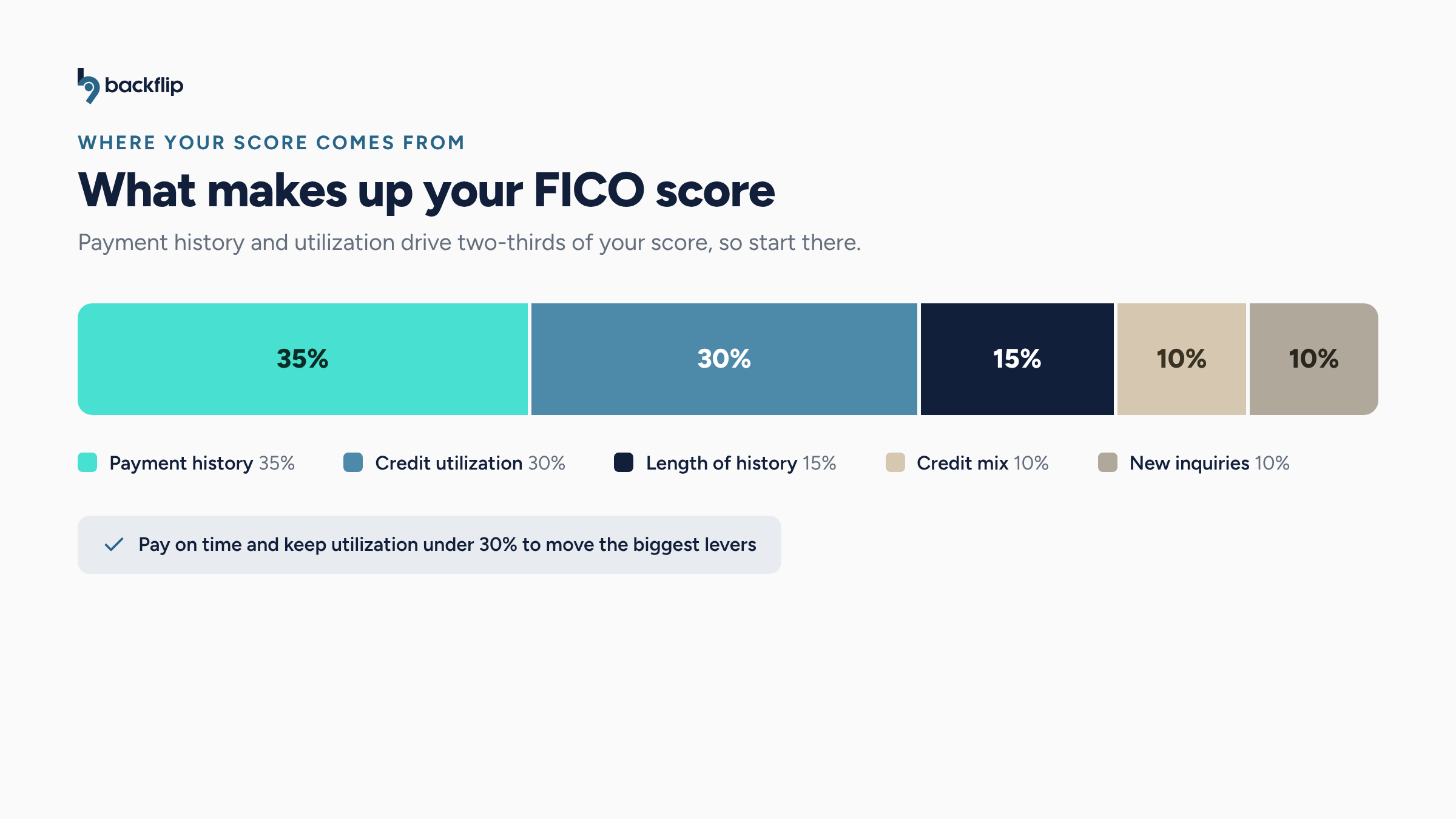
Your FICO score is built from five factors. Knowing the weights tells you where to focus first.
| Factor | Weight | What it means |
|---|---|---|
| Payment history | ~35% | Pay every bill on time, every time |
| Credit utilization | ~30% | Keep balances under 30% of your limits |
| Length of credit history | ~15% | Keep older accounts open and in good standing |
| Credit mix | ~10% | A range of account types shows you can manage credit |
| New inquiries (hard pulls) | ~10% | Fewer recent applications is better |
What changed for 2026
Credit scoring is not static, and a few 2026 updates work in your favor if you know about them.
New mortgage scoring models. In April 2026, the Federal Housing Finance Agency and HUD announced that Fannie Mae, Freddie Mac, and FHA will accept two newer credit score models, VantageScore 4.0 and FICO Score 10T, the first new models approved in decades. These models use “trended data,” which looks at how your balances move over time rather than a single snapshot. The practical takeaway: steadily paying balances down, not just carrying them, now counts in your favor. They also factor in on-time rent payments.
Free weekly credit reports are permanent. You can now pull your reports from all three bureaus free every week at AnnualCreditReport.com, not just once a year. There is no reason to be surprised by what a lender sees.
Rent and bills can count. Services like Experian Boost and rent-reporting tools can add your on-time rent, utility, phone, and even some streaming payments to your credit file, which can lift a thin profile quickly.
How to boost your credit score: 9 strategies for investors
1. Check your credit reports free every week
Pull your reports regularly at AnnualCreditReport.com and read them closely. Look for errors or discrepancies that unfairly drag down your score. A foreclosure that should have aged off but did not, or an account that is not yours, can quietly cost you. Dispute inaccuracies in writing with the bureaus right away.
2. Keep your credit utilization under 30%
Utilization is about 30% of your score, so keep balances low relative to your limits. The rule of thumb is to use less than 30% of your total credit, and lower is better. On a $10,000 limit, try to stay under $3,000. This applies to each card and to your total across all cards. If you keep running high, ask for a credit limit increase but keep your spending flat, which improves the ratio.
3. Pay on time, every time
Payment history is about 35% of your score, the single biggest factor. One late payment can do real damage. Set reminders or automate payments so you never miss a due date.
4. Get credit for the rent and bills you already pay
This is one of the fastest newer levers. Rent-reporting services and tools like Experian Boost can add your on-time rent, utilities, and phone payments to your credit file. If you have a thin file or are early in your investing career, this can raise your score from payments you are already making.
5. Lower your debt-to-income ratio
Lenders assess your debt-to-income (DTI) ratio alongside your score. A lower DTI signals a healthy balance between what you earn and what you owe. Pay down existing debts, especially high-interest ones, and be cautious about taking on new obligations before a big application.
6. Be strategic about hard inquiries
Every loan application can trigger a hard inquiry that dips your score temporarily. Two things help. First, when you are rate-shopping the same type of loan, multiple inquiries inside a short window (often 14 to 45 days) usually count as one. Second, choose lenders that protect your score. Backflip does not run a hard credit pull on a non-binding loan application, so you can explore your options with your score intact.
7. Keep a healthy credit mix and history
A range of account types (cards, installment loans, and so on) shows lenders you can manage credit, and older accounts help your history length. Keep long-standing accounts open. If your file is short, being added as an authorized user on someone else’s well-managed card can help, though some newer scoring models weight authorized-user accounts less than before, so treat it as a boost, not a silver bullet.
8. Build business credit as you scale
As you grow a portfolio, build credit under your business, not just your personal name. Set up your entity, open business accounts, and work with vendors and lenders that report to business credit bureaus. Separating business and personal credit protects your personal score as your borrowing grows and is a step most serious investors take on the way to scaling.
9. Keep learning
Credit and lending rules change, as 2026 shows. Stay informed with strategies specific to real estate investing, and lean on professionals when a decision is big. Backflip regularly hosts free webinars with financial and legal advisors who can answer questions about your business.
The Backflip advantage: explore financing with no hard pull
Here is where the right lender protects the score you are working to build. Most lenders run a hard credit pull the moment you apply, which dings your score just for looking. Backflip does not. When you submit a non-binding loan application with Backflip, we do not perform a hard credit pull, so you can see your options without any hit to your score, then move forward only when the deal is right.
Explore your options, protect your score: start a non-binding application or create your free Backflip investor account.
Frequently asked questions
What is the fastest way to boost your credit score?
The fastest levers are paying down balances to get your utilization under 30%, disputing and removing errors on your credit reports, and adding on-time rent and bill payments to your file through a service like Experian Boost. Paying on time and limiting new hard inquiries protect your progress over the longer term.
What credit score do I need for a fix and flip loan with Backflip?
At Backflip, a FICO score over 680 qualifies you for the best terms. If your FICO score is below 640, you can still get a loan with a qualified guarantor. Keeping your score above 680 gives you the most options and the strongest terms.
Does applying with Backflip hurt my credit score?
No. A non-binding loan application with Backflip does not trigger a hard credit pull, so exploring your financing options does not affect your credit score. That lets you shop deals and terms without the usual hit from applying.
Does checking my own credit report lower my score?
No. Checking your own credit is a soft inquiry and does not affect your score. You can pull your reports free every week at AnnualCreditReport.com without any impact, so there is no reason not to monitor them.
What is a good credit utilization ratio?
Keep your credit utilization under 30% of your available credit, and lower is better. This applies to each card and to your total across all cards. If you tend to run high, request a credit limit increase while keeping your spending the same to improve the ratio.
Does paying rent build credit?
It can. On its own, rent is not automatically reported, but rent-reporting services and tools like Experian Boost can add your on-time rent and other bills to your credit file. The newer 2026 mortgage scoring models (FICO 10T and VantageScore 4.0) also factor in on-time rent payments.
How long does it take to improve your credit score?
It depends on where you start and what you fix. Correcting an error or lowering utilization can show up within a billing cycle or two, while building payment history and length of credit takes months. Improving credit is rarely overnight, but consistent habits compound.
Disclaimer: This information is intended for educational purposes only. It is not legal, financial, or investment advice and may not apply to your specific needs. Credit score thresholds, scoring models, and lender terms vary and are subject to change and underwriting. To obtain advice tailored to your circumstances, consult a licensed professional advisor.