DSCR Loan Benefits: Why So Many Investors Use Them
A DSCR loan lets you qualify for a rental property mortgage based on what the property earns, not what you earn. That one shift explains nearly all of the DSCR loan benefits investors talk about: no tax returns, no personal debt-to-income math, no conventional ceiling on how many rentals you can finance, and the option to close in your LLC. It also explains why DSCR lending grew so fast in 2025 and 2026. Below, we cover what a DSCR loan is, the data behind the boom, the tradeoffs nobody puts in the ad, and how to tell if one fits your next deal. Already have a property in mind? Request a free, non-binding DSCR quote from Backflip in a few minutes.
Why are DSCR loans so popular?
DSCR loans are popular because they underwrite a rental the way an investor already thinks about it: does the rent cover the payment? A DSCR (debt service coverage ratio) loan qualifies the property on its own cash flow, so the lender does not need your W-2s, pay stubs, or tax returns. In practice, investors use DSCR loans to:
- Qualify without personal income documents, which helps self-employed borrowers and anyone whose tax return is full of legitimate write-offs.
- Keep buying after conventional financing tops out, since Fannie Mae limits most borrowers to 10 financed properties.
- Close in an LLC (limited liability company) instead of their personal name.
- Move faster, because underwriting centers on the appraisal and the rent, not a full review of your personal finances.
- Refinance a finished flip into a long-term rental, the last step of the BRRRR strategy (buy, rehab, rent, refinance, repeat).
The data backs this up. Optimal Blue figures reported by HousingWire show investor and DSCR loans grew from 22% to 35% of all non-traditional mortgages (loans that skip the usual income checks) between August 2022 and August 2026.
Have a rental in mind? See what your property could qualify for with Backflip. It is free, non-binding, and built for real estate investors.
What is a DSCR loan?
A DSCR loan is a mortgage for investment properties that qualifies based on the property’s cash flow instead of your income. The lender divides the monthly rent by the monthly payment. If the rent covers the payment, the property can qualify on its own. Because it skips the income checks used for regular home loans, it falls into a group of mortgages lenders call “non-QM.” That label just means it is not a standard home loan, so the usual paperwork rules do not apply.
This article focuses on the DSCR loan benefits that made these loans take off, and what they mean for you. For the full step-by-step on requirements and qualifying, read our companion guide: What is a DSCR loan and how does it work?
DSCR loan terms, defined
Lending has its own vocabulary, and most of it gets thrown around without explanation. Here are the terms you will see in this guide and on any DSCR term sheet.
| Term | What it means |
|---|---|
| DSCR (debt service coverage ratio) | Monthly rent divided by the monthly payment. A DSCR of 1.25 means the rent is 125% of the payment. |
| PITIA | Principal, interest, taxes, insurance, and association dues such as HOA (homeowners association) fees. It is the full monthly cost of carrying the loan. |
| DTI (debt-to-income ratio) | The share of your pre-tax monthly income that goes to debt payments, as the CFPB explains. Conventional lenders cap it. DSCR lenders do not calculate it. |
| Non-QM | Lender shorthand for a mortgage that is not a standard home loan. These loans skip the usual W-2 and tax return checks. DSCR loans and bank statement loans are common examples. |
| LTV (loan-to-value) | The loan amount divided by the property value. An 80% LTV purchase means you bring a 20% down payment. |
| Market rent | The rent an appraiser estimates the property should earn, usually on a rent schedule (Fannie Mae Form 1007 for one unit, or Form 1025 for two to four units). |
| Prepayment penalty | A fee for paying the loan off early. It is common on DSCR loans and often steps down each year, such as 5%, 4%, 3%, 2%, then 1%. |
| BRRRR | Buy, rehab, rent, refinance, repeat. A strategy that usually ends with a DSCR cash-out refinance. |
How is DSCR calculated?
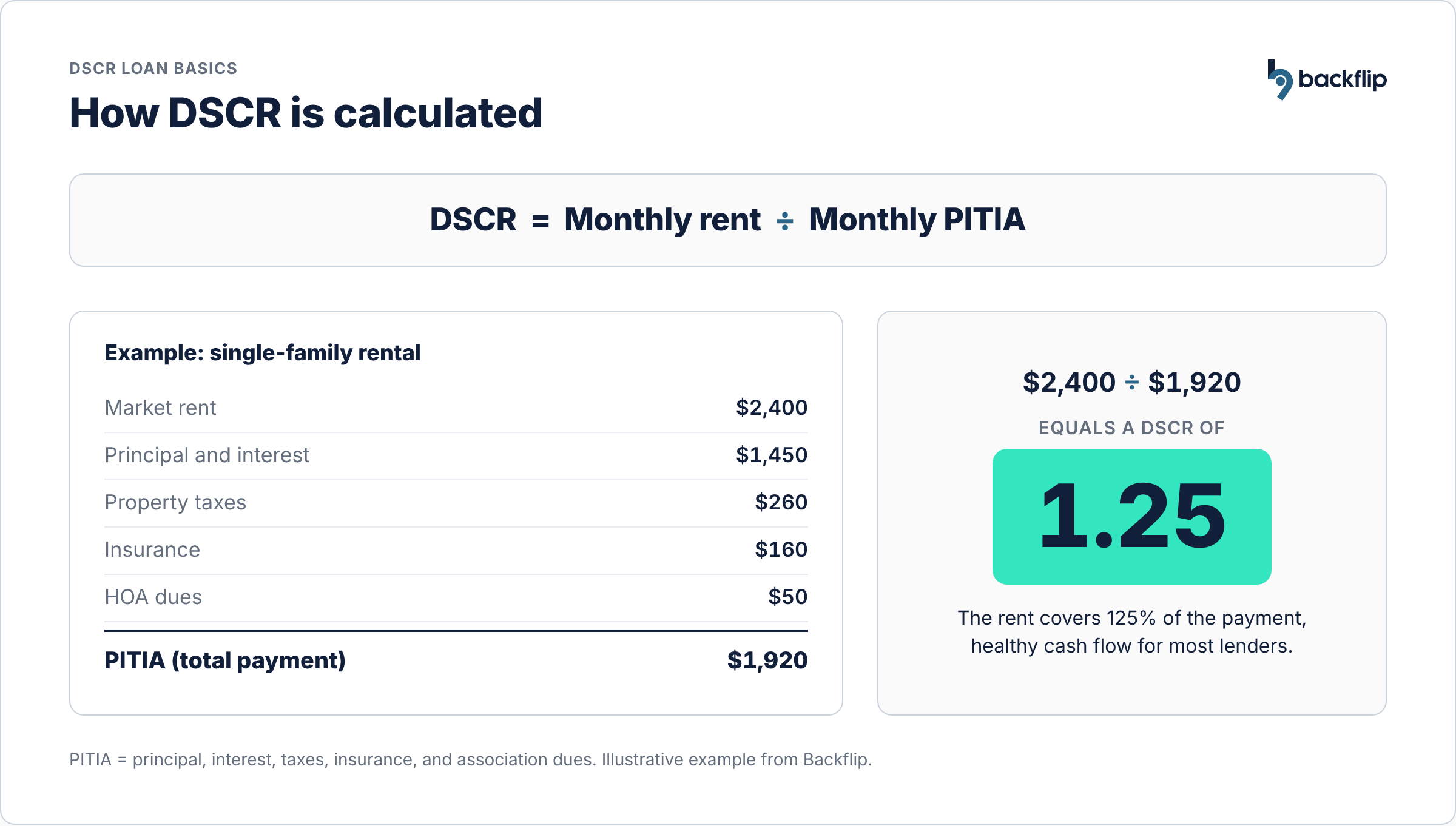
The formula is simple:
DSCR = Monthly rent ÷ Monthly PITIA
Say you are buying a single-family rental with an appraised market rent of $2,400 a month. Here is how a lender would score it:
| Line item | Monthly amount |
|---|---|
| Market rent | $2,400 |
| Principal and interest | $1,450 |
| Property taxes | $260 |
| Insurance | $160 |
| HOA dues | $50 |
| PITIA (total payment) | $1,920 |
| DSCR ($2,400 ÷ $1,920) | 1.25 |
A 1.25 DSCR is a healthy number. As a rule of thumb:
- Below 1.00: the rent does not cover the payment. Few programs will lend, and the ones that do usually want more cash down, stronger credit, and investor experience.
- 1.00: break-even. This is the floor for many lenders.
- 1.20 to 1.25 and up: comfortable cash flow, and typically where pricing gets better.
Want to skip the spreadsheet? The free Backflip app pulls rent comps and runs your DSCR for you, so you know where a deal stands before you apply. For more detail on ratios and requirements, see our full DSCR loan guide.
How fast are DSCR loans growing? The 2025 to 2026 numbers
“Popular” is an easy word to throw around, so here is what the industry data actually shows.
| Metric | Figure | Source |
|---|---|---|
| Investor and DSCR loans’ share of non-traditional mortgages | 22% (Aug. 2022), 28% (Aug. 2025), 35% (Aug. 2026) | Optimal Blue, via HousingWire |
| Growth in investor and DSCR rate-lock volume | Up about 130% from January 2022 through August 2026 | Optimal Blue, via HousingWire |
| Projected non-traditional mortgage lending in 2026 | About $175 billion | Bank of America, via HousingWire |
| Small investors’ share of investor home purchases (2025) | About 63%, the highest in more than 15 years | Realtor.com Investor Report, via Real Estate News |
| Mega investors’ share of investor purchases (2025) | 7.5%, a 14-year low | Realtor.com Investor Report |
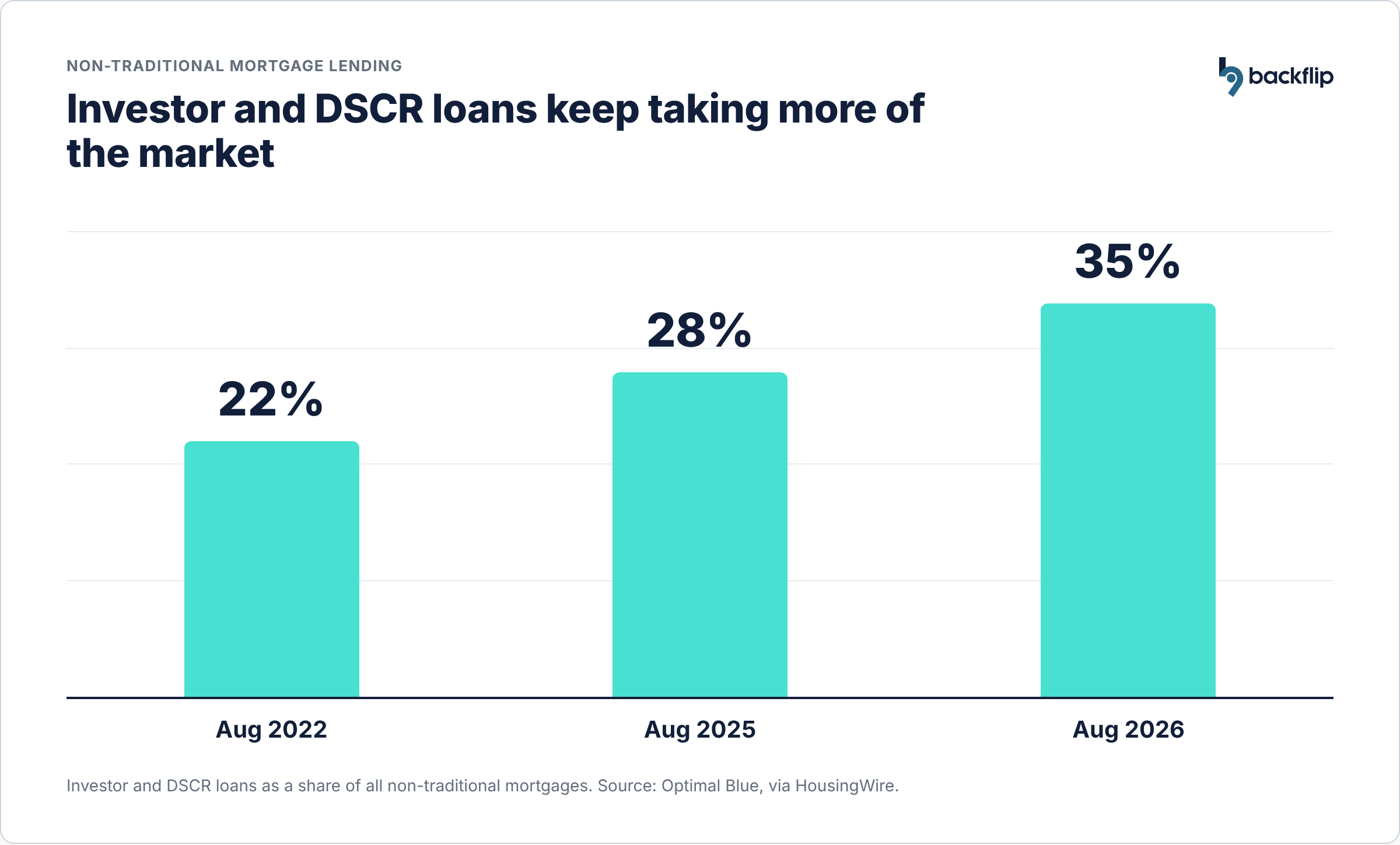
Two things stand out. First, DSCR is no longer a niche product. It now makes up more than a third of non-traditional mortgage lending, and that steady demand keeps more lenders offering it. Second, the people buying rentals have changed. Small, independent investors now make up the clear majority of investor purchases, and that is exactly the borrower DSCR lending was built for. Even mainstream lenders took notice: HousingWire reported that Rocket Pro launched its first DSCR product for investment properties in November 2025.
Part of that 63%? Get a non-binding DSCR quote from Backflip, a lender built for independent investors.
What changed in 2025 and 2026?
DSCR loans have existed for years. What changed is the market around them. Four shifts made the DSCR loan benefits below matter a lot more to independent investors.
Rates swung hard, so cash flow became the filter
According to Freddie Mac’s Primary Mortgage Market Survey, the average 30-year fixed rate bottomed at 5.98% in late February 2026, climbed to about 7.4% in early October, and sat at 7.18% on November 5, 2026. When rates move a full point in a few months, the only question that matters on a rental is whether the rent still covers the payment. A DSCR loan builds that question into the underwriting. To be clear, a DSCR loan does not protect you from rates. A higher rate raises your PITIA and lowers your DSCR. It just makes the math visible before you commit.
Small investors took over the buyer pool
Realtor.com’s annual Investor Report found that investors with fewer than 10 purchases made up nearly 63% of investor home buying in 2025, while the share bought by mega investors (350 or more purchases) fell to 7.5%. Many of these smaller buyers are business owners, contractors, and full-time investors. Their income is real, but it rarely looks clean on a conventional loan application. DSCR lending meets them where they are.
New federal limits on Wall Street landlords
On January 20, 2026, the White House issued an executive order targeting large institutional purchases of single-family homes. Congress followed with the 21st Century ROAD to Housing Act, which became law on July 11, 2026 and takes effect January 7, 2027. It restricts entities that control 350 or more single-family homes from buying more, with exceptions such as purpose-built build-to-rent communities. If you own a handful of rentals, the law does not apply to you. Over time, it may mean less competition from large funds on entry-level homes, although how much that shows up in your market is still an open question.
More borrowers with nontraditional income
Industry leaders quoted by HousingWire point to tight inventory and a growing share of nontraditional wage earners as the main drivers of DSCR demand. Self-employed borrowers, 1099 contractors, and investors who live on rental income all run into the same wall with conventional underwriting. DSCR loans remove that wall.
Want a lender who understands investor income? Start a free inquiry with Backflip and talk through your deal with a dedicated Account Executive.
7 DSCR loan benefits investors care about
Here is a closer look at each of the DSCR loan benefits, including the fine print that comes with each one.
1. No W-2s, pay stubs, or tax returns
This is the headline among all the DSCR loan benefits, and for good reason. Experienced investors often show modest taxable income on purpose. Depreciation, repairs, mortgage interest, and business expenses can shrink a profitable rental portfolio into a small number on a tax return. That is great at tax time and terrible on a conventional loan application, where the lender qualifies you on that small number.
A DSCR lender looks at the property’s rent instead. You still need acceptable credit, documented funds for the down payment and closing costs, and sometimes reserves. If your score needs work first, our guide to the best ways to boost your credit score is a good place to start.
Tired of sending tax returns to a bank that does not get investing? Request a cash-flow-based quote from Backflip.
2. No personal DTI cap, and no 10-property ceiling
Conventional investment loans hit two limits. The first is DTI: every new mortgage adds to your monthly debt, and eventually your ratio is too high to qualify. The second is a hard count. Under Fannie Mae’s Selling Guide, a borrower financing an investment property can have up to 10 financed properties, and that count includes your own home.
DSCR lenders do not run your DTI, and they do not stop at 10. Each property qualifies on its own rent. One caveat: “unlimited” is a marketing word. DSCR lenders still pull your credit, check your mortgage payment history, and set their own exposure limits per borrower, usually measured in total loan dollars. The difference is that your ceiling is set by how well your properties perform, not by your W-2.
Already at nine or ten financed properties? See how Backflip can finance your next one.
3. You can close in your LLC
An LLC (limited liability company) is a business entity that holds title to the property. Most conventional lenders want title in your personal name. DSCR loans are business-purpose loans, so closing in an LLC is normal, and you can close a Backflip DSCR loan in your LLC. Investors like this because it keeps rental debt and income separate from personal finances, makes bookkeeping cleaner, and contains liability at the entity level.
Know what an LLC does not do, though. Lenders almost always require a personal guarantee from the owners. Moody’s reviewed about 30 DSCR lenders and aggregators and found that 93% require a personal guarantee on loans to LLCs, according to HousingWire. So the LLC is a structure for the property, not a shield from the loan. Talk to your attorney or CPA (certified public accountant) about the right setup before you form the entity.
Ready to finance under your LLC? Talk to a Backflip Account Executive.
4. Faster, simpler closings
Conventional purchase loans commonly take 30 to 45 days because the lender is auditing your personal finances along with the property. DSCR underwriting is narrower. It focuses on the appraisal, the rent schedule, your credit, and your entity documents, so a clean file can often close in two to three weeks. The appraisal and title work usually set the pace.
Want to speed things up? Have your entity documents ready before you apply: articles of organization, operating agreement, EIN (employer identification number) letter, and a current certificate of good standing. If you are buying a property that needs work first, a short-term loan from one of the fastest hard money lenders may be the better first step, with a DSCR refinance after the rehab.
5. Long-term financing built for holding
Most DSCR loans are 30-year mortgages, the same horizon as a conventional loan, and many lenders offer a fixed rate, an adjustable rate, or an interest-only period. Interest-only means you pay only interest for a set number of years, which lowers the payment and can raise your DSCR. The tradeoff is that you build no equity through principal paydown during that period, and the payment rises when it ends. Use it for cash flow strategy, not to force a weak deal to qualify.
6. A clean exit for flips: the BRRRR refinance
This is where DSCR loans and fix and flip loans work together. You buy and renovate with a short-term RTL (residential transition loan), lease the property, then refinance into a 30-year DSCR loan that pays off the short-term debt. In a well-structured deal, the cash-out refinance returns much of your original capital so you can do it again.
Backflip offers both sides of that strategy, so if you fund the flip with Backflip, you can refinance into a Backflip DSCR loan without switching lenders. Our guide on how to turn a flip into a rental walks through the full BRRRR path.
Planning a BRRRR? Map out the flip and the refinance with Backflip before you buy.
7. More options for short-term rentals (at some lenders)
As vacation and nightly rentals grew, some DSCR lenders started accepting short-term rental income for qualification, using a property’s booking history or projections from third-party rental data. Rules vary widely. Some lenders use only long-term market rent, some accept twelve months of booking history, and some accept projections. If you plan to run a property as a short-term rental, ask how the lender underwrites that income before you pay for an appraisal. Backflip’s DSCR loans qualify on long-term market rent, so your Account Executive can tell you up front whether the deal works on that basis.
DSCR loan vs conventional loan vs fix and flip loan
DSCR is one tool, not the only one, and the DSCR loan benefits only help if the loan fits the deal. Here is how it compares with the two loans investors most often weigh it against.
| DSCR loan | Conventional investment loan | Fix and flip loan (RTL) | |
|---|---|---|---|
| Best for | Buy-and-hold rentals | W-2 earners with a few rentals | Buying and renovating to sell or refinance |
| Qualifies on | Property rent vs. PITIA | Personal income and DTI | The deal (purchase, rehab budget, after-repair value) plus credit |
| Income documents | None | W-2s, pay stubs, tax returns | Typically none |
| Typical term | 30 years | 15 or 30 years | About 6 to 18 months |
| Property count limit | No DTI-based count; lender exposure limits apply | Up to 10 financed properties (Fannie Mae) | Set by each lender |
| Title in an LLC | Standard | Generally personal name | Standard |
| Typical timeline | Often 2 to 3 weeks | Commonly 30 to 45 days | Can be under 2 weeks |
| Rate | Higher than conventional | Lowest of the three | Highest; short-term, interest-only |
Backflip offers DSCR rental loans and fix and flip loans on one platform, which matters most when a deal needs both. If you are still comparing short-term lenders, see our breakdown of the best hard money lenders for scaling flips.
Not sure which loan fits your deal? Submit it to Backflip and an Account Executive will walk you through the options.
What are the downsides of DSCR loans?
The DSCR loan benefits are real, but these loans are not free money. Before you apply, know the tradeoffs.
- Higher rates. For the same borrower and property, a DSCR loan usually prices above a conventional investment loan. You are paying for flexibility and lighter documentation.
- More cash down. Expect to put down 20% to 25% in most cases. Lower leverage is part of how lenders manage the risk of not verifying income.
- Prepayment penalties. A five-year step-down is common. On a $300,000 balance, a 4% penalty in year two is $12,000. If you might sell or refinance within a few years, ask about a shorter penalty, which usually costs a little more in rate.
- The property has to carry itself. In markets where taxes and insurance have climbed, a deal that looked fine on paper can drop below 1.00 once the full PITIA is counted. Run the numbers with real quotes, not estimates.
- Business purpose only. You cannot live in a property financed with a DSCR loan. It must be held as an investment.
- Real verification. Cotality data reported by HousingWire found that at the end of Q2 2026, 1 in 44 investment property mortgage applications showed elevated fraud risk, versus 1 in 119 across all applications. Lenders respond by checking entities, appraisals, and rent carefully. A clean, organized file is the fastest file.
Want a second set of eyes on your numbers? Analyze the deal free in the Backflip app, then request a non-binding quote when it pencils.
Who should use a DSCR loan?
The DSCR loan benefits pay off most if you are:
- Self-employed, a business owner, or a full-time investor whose tax return understates your real income
- Close to, or past, the 10 financed property limit on conventional loans
- Buying or refinancing a rental that cash flows at a DSCR of 1.00 or better
- Holding properties in an LLC, or planning to
- Finishing a flip that you want to keep as a rental
A DSCR loan is probably not your best option if you are:
- Buying a home you plan to live in
- A W-2 earner buying your first rental who qualifies conventionally and wants the lowest possible rate
- Counting on appreciation because the rent does not cover the payment
- Buying a property that needs a heavy rehab before it can be rented (start with a fix and flip loan, then refinance)
How to get a DSCR loan with Backflip
Backflip is built for independent real estate investors, so getting a DSCR rental loan starts with the same tools you would use to analyze any deal. Backflip lends on single-family homes, condos, duplexes, triplexes, and fourplexes, and lends to anyone who qualifies financially. Investors with recently completed projects often secure better terms.
- Run the numbers. Create a free Backflip investor account and use rent comps and deal tools to estimate your rent, payment, and DSCR. Our roundup of the best free comps apps covers how to sanity-check value too.
- Request a quote. Submit the property in your Loan Dashboard. It is free and non-binding.
- Talk it through. A dedicated Account Executive reviews the rent, your entity, and the terms with you.
- Appraise, underwrite, and close. The lender confirms value and market rent, reviews credit and entity documents, and you close in your LLC.
Start now, free and non-binding: request a DSCR loan quote, create your free investor account, or download the Backflip app. You can also browse all Backflip loan programs.
Frequently asked questions
Why are DSCR loans so popular in 2026?
DSCR loans are popular because they qualify a rental on its own cash flow instead of the investor’s personal income. That removes the tax return, DTI, and 10-property limits that stop many investors on conventional loans. Volatile rates, a buyer pool now dominated by small investors, and more lenders offering DSCR products all accelerated demand in 2025 and 2026. Optimal Blue data shows investor and DSCR loans grew from 22% to 35% of non-traditional mortgage lending between 2022 and 2026.
What are the main DSCR loan benefits?
The main DSCR loan benefits are qualifying without W-2s, pay stubs, or tax returns; no personal debt-to-income calculation; no conventional cap on how many properties you finance; the ability to close in an LLC; faster closings; 30-year terms built for holding; and a clean refinance path out of a fix and flip loan. The tradeoffs are higher rates, a larger down payment, and common prepayment penalties.
Are DSCR loans a good idea when rates are high?
They can be, as long as the property still cash flows at today’s rate. A higher rate raises your payment and lowers your DSCR, so a deal that worked at 6% may not work at 7%. The upside is that DSCR underwriting forces you to confirm the rent covers the payment before you buy. Run the numbers at the current rate, not the rate you hope to refinance into later.
Is there a limit to how many DSCR loans I can have?
There is no DTI-based or 10-property limit like there is on conventional loans, because each DSCR loan qualifies on its own property’s rent. Lenders do still set their own exposure limits per borrower, usually in total loan dollars, and they review your credit and mortgage history on every loan.
Do I need an LLC to get a DSCR loan?
Many DSCR lenders prefer or require that you borrow through a business entity such as an LLC, and Backflip closes DSCR loans in your LLC. Most lenders also require a personal guarantee from the owners, so the LLC does not remove your personal responsibility for the loan.
Can I use a DSCR loan for an Airbnb or short-term rental?
Some DSCR lenders accept short-term rental income based on booking history or third-party projections, while others qualify only on long-term market rent. Backflip’s DSCR loans qualify on long-term market rent. If your plan is a nightly rental, ask any lender how they underwrite that income before you order an appraisal.
Does the new federal law on institutional investors affect small investors?
No. The 21st Century ROAD to Housing Act, which became law on July 11, 2026 and takes effect January 7, 2027, restricts entities controlling 350 or more single-family homes from buying more. Independent investors with smaller portfolios are not the target, and the law could reduce competition from large funds on some entry-level homes.
Can I refinance a fix and flip loan into a DSCR loan?
Yes. Refinancing a finished, leased flip into a 30-year DSCR loan is the final step of the BRRRR strategy. Backflip offers both fix and flip loans and DSCR rental loans, so you can refinance without changing lenders.
Are DSCR loan rates higher than conventional mortgage rates?
Usually, yes. Because the lender does not verify personal income, DSCR loans typically price above a conventional investment loan for the same borrower. Your rate depends on your credit score, loan-to-value, DSCR, loan amount, property type, and prepayment penalty choice.
Sources
- HousingWire: DSCR loan volume surges despite fraud risks and scrutiny (September 2026; Optimal Blue, Bank of America, Cotality, and Moody’s data)
- HousingWire: Why DSCR demand ramped up in 2025 and will continue into 2026 (December 2025)
- HousingWire: 2026 forecast for non-traditional mortgage lending (September 2026)
- Real Estate News: Mega-investor activity fell to 14-year low in 2025 (Realtor.com Investor Report, June 2026)
- Freddie Mac: Primary Mortgage Market Survey
- Fannie Mae Selling Guide B2-2-03: Multiple Financed Properties for the Same Borrower
- Latham & Watkins: 21st Century ROAD to Housing Act Becomes Law (July 2026)
- Consumer Financial Protection Bureau: What is a qualified mortgage?
This article is for general information only and is not a loan offer, financial, legal, or tax advice, or a commitment to lend. Market data is drawn from the third-party sources listed above and reflects conditions as of their publication dates. DSCR loan products, rates, requirements, and eligibility vary by borrower, property, and transaction and are subject to underwriting and applicable terms. Creating an account and requesting a quote are free and non-binding. Consult a qualified professional about your situation, and confirm current terms directly with any lender before applying.