Hard Money Lenders for Fast Draws: Fix and Flip Loans
When you’re running more than one flip at a time, the loan that wins isn’t always the one with the biggest headline number. Instead, it’s the one that gets your rehab money back to you fast, keeps your cash working, and shows you where every draw stands without a phone call. In short, that’s what separates good hard money lenders for fast draws from the rest.
The short answer: Backflip is the lender for investors who need fast draws and high leverage on every project. You can finance up to 90% of the purchase price and up to 100% of the rehab budget. You can also request and track every draw from the Backflip Dashboard and draw against work in progress, not just finished phases. On top of that, Backflip reported in October 2026 that it typically funds draw requests in under two days, with one flat $180 fee per draw.
Running more than one project?
Get your fix and flip loan termsAnalyze a deal for free
In this guide
- What makes a hard money lender fast on draws?
- How to request and track draws in the Backflip Dashboard
- How fast are Backflip draws?
- Managing draws across multiple projects
- High leverage fix and flip financing from Backflip
- Loans for first-time investors vs. experienced investors
- How Backflip compares to other hard money lenders
- Frequently asked questions
What makes a hard money lender fast on draws?
First of all, most fix and flip financing works the same way. The lender funds part of the purchase at closing and then sets aside your renovation budget in a rehab holdback. Afterward, the lender releases that money in stages called draws: you (or your contractor) complete the work, an inspector verifies it, and the lender sends you the money for that portion.
So “fast funding and draws” really comes down to five things:
- How quickly a request turns into cash. Every day a draw sits in review, your money sits idle instead of paying the next crew.
- What counts as reimbursable. For example, some lenders only pay for fully finished phases. Others, however, reimburse verified work in progress, which means smaller, more frequent draws and less cash out of your pocket at any one time.
- How inspections happen. In contrast, an in-person inspection for every draw adds scheduling time. Mobile, photo-based inspections cut it.
- What each draw costs. Inspection, wire, and processing fees also come out of every draw. A flat fee is easier to budget than a stack of line-item fees.
- How easy it is to see status. When you have to email someone to find out where your draw is, you’re losing time. On the other hand, a dashboard that shows every draw and every dollar remaining saves it.
Backflip covers all five. Here’s how it works in practice.
How to request and track draws in the Backflip Dashboard
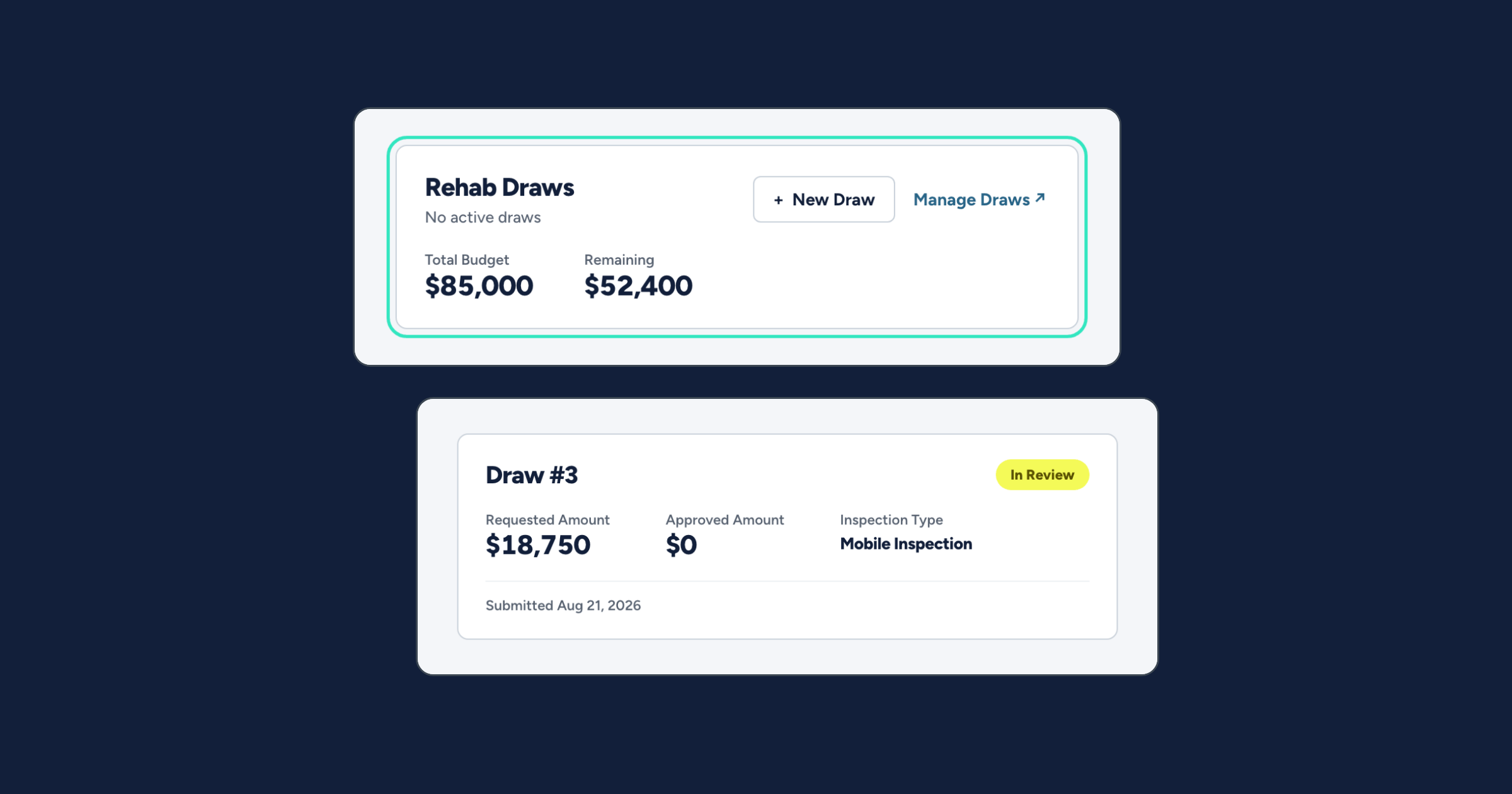
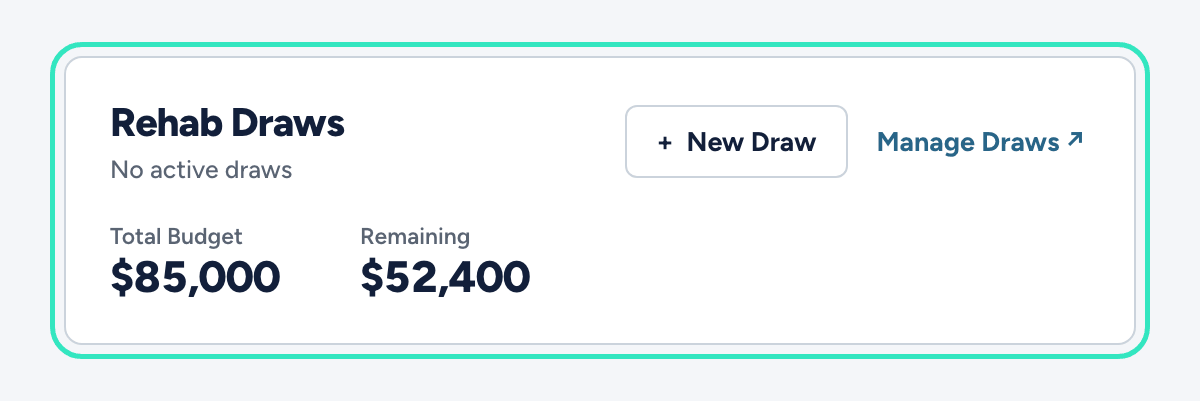
Every Backflip loan gets its own page in the Backflip Dashboard. On top of that, every loan page has a Rehab Draws card showing your rehab budget and what’s left to draw. Draws, budget changes, and status updates all live there, so you’re never digging through email threads to figure out where your money is.
Step 1: Open your loan
To begin with, log in, go to Loans, and open the property. The Rehab Draws card has two buttons:
- + New Draw starts a new draw request.
- Manage Draws opens your full draw history for that property.
Step 2: Request the draw
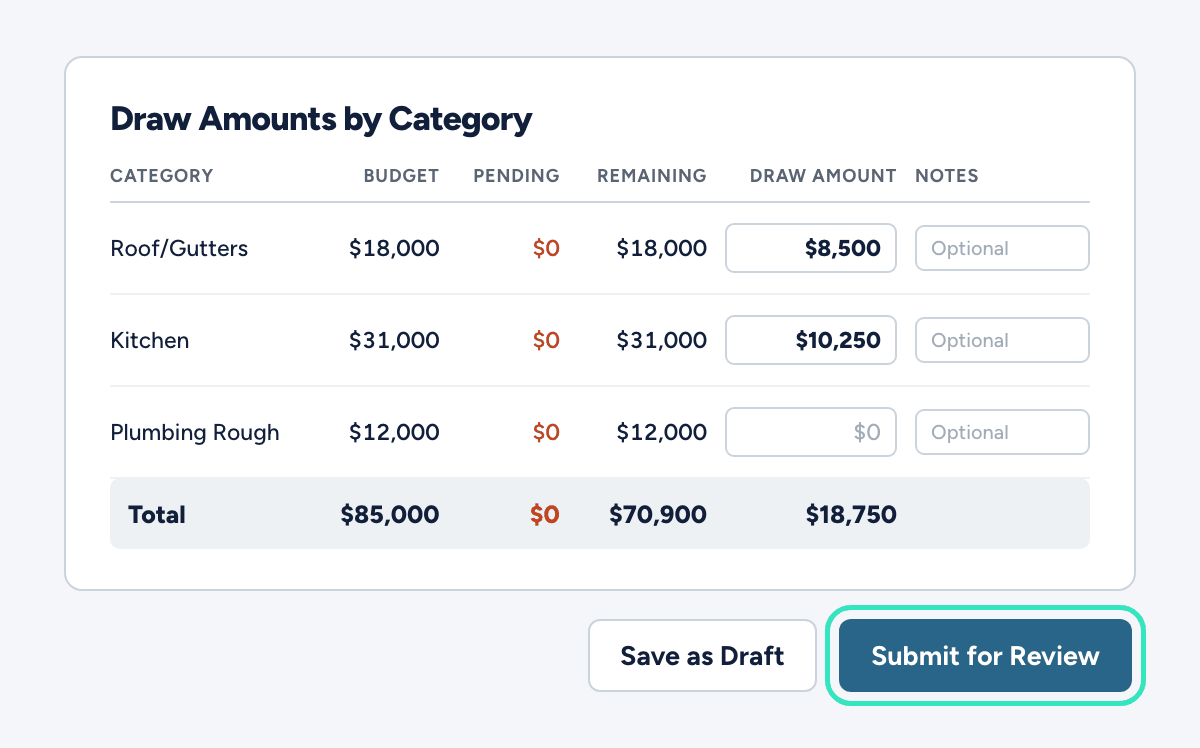
Then enter the amount you’re drawing against each budget category. For each one, the form shows the budget, anything already pending, and what’s remaining, so you can’t accidentally overdraw a line item. Additionally, attach your invoices, choose a mobile or in-person inspection, and confirm who the inspector should contact to get into the property.
Click Submit for Review when you’re ready, or Save as Draft if you want to finish it later.
Step 3: Track it until it’s paid
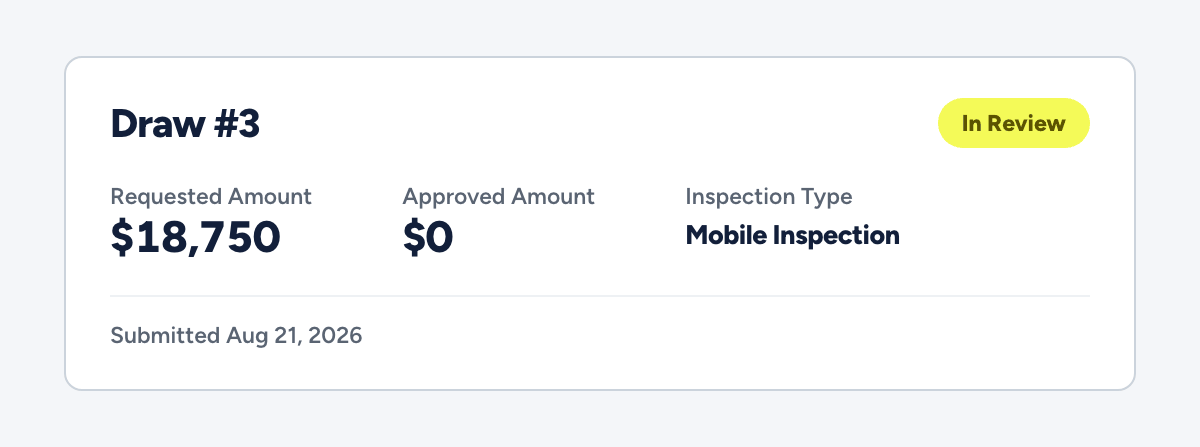
Then every draw gets its own page with a clear status: submitted, in review, approved, and paid. You’ll also see what you requested, the approved amount, the inspection, and a full history of everything that’s happened on that draw.
Need to move budget between categories?
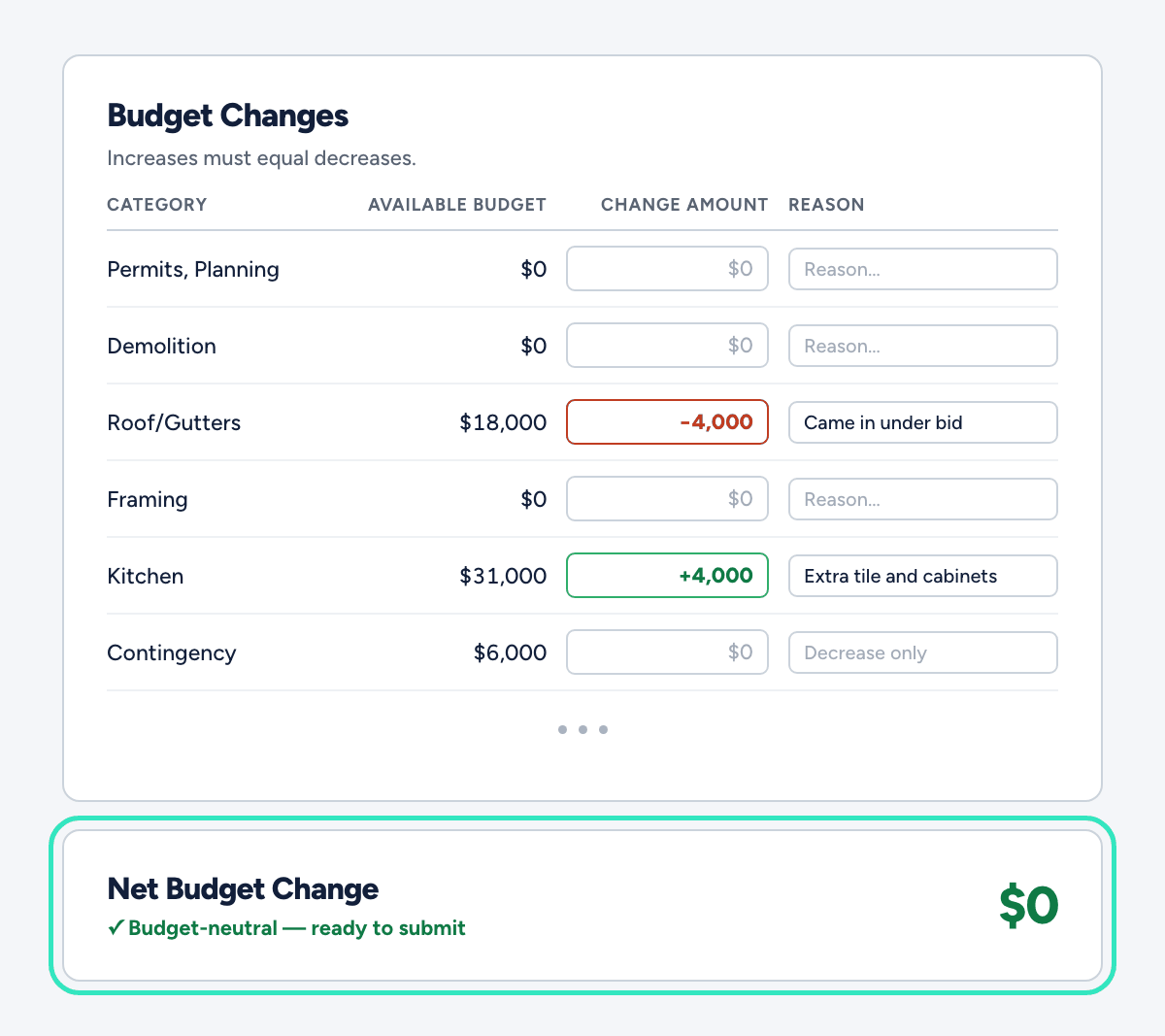
Then open Manage Draws and select Request Budget Change.

However, a change order only moves money between categories; it doesn’t add new money. The form lists every rehab category with a reason field, but you only change the two you’re moving money between: lower one, raise the other by the same amount, and explain why. The form keeps a running total and won’t let you submit until the net change equals $0. Also, you can only lower contingency, not raise it.
For a full walkthrough of each stage, read Backflip’s guide to faster draw funding.
See how draws work on your next deal.
Start your loan inquiryDownload the Backflip app
How fast are Backflip draws?
In fact, Backflip’s October 2026 app announcement reports that the team typically funds draw requests in under two days. A few details make that possible:
- Same-day processing. The draws team processes requests the same day when you submit them before 3 PM Eastern time (ET).
- Mobile inspections. Your first and final inspections happen on site. However, you can usually handle the draws in between with a mobile inspection from your phone, which removes the wait for an inspector’s calendar.
- Whole-project inspections. The inspector reviews the entire project rather than just the line items you requested. So if you’ve completed other work, Backflip can often reimburse it in the same draw.
- Work in progress counts. For example, when your flooring is half complete, you can request 50% of the flooring line item. So you don’t have to wait for a whole phase to finish.
- Help with materials. Backflip can also reimburse up to 50% of a materials line item when the materials arrive on site and the inspector verifies them. However, deposits and materials still in transit aren’t eligible.
- No cap on draw count. Take as many draws as your project needs, as long as it’s progressing. Also, one request can include as many line items as you want, which helps because you can have one draw or one budget change open at a time.
- One flat fee. Backflip charges $180 per draw request on fix and flip loans and takes it out of the draw. Since it’s one flat fee, there’s no separate inspection or wire fee stacked on top.
- A real team behind it. Backflip handles draws in-house, so you can reach the draws team directly at [email protected].
Draw timing is typical, not guaranteed. For example, missing documents, property access, and bank processing can all add time.
Why draw speed matters more than you’d think
Basically, fast draws shrink the amount of your own cash stuck between paying contractors and getting your money back. For instance, here’s a hypothetical $60,000 rehab split into $15,000 phases, comparing a lender that only pays on finished phases and takes a week, against smaller in-progress draws that fund quickly:
| Draw rhythm on a $60,000 rehab | Most cash you’d have out of pocket at once |
|---|---|
| Two $15,000 phases paid before a slow first draw arrives | $30,000 |
| One draw per $15,000 phase, funded before the next payment is due | $15,000 |
| About $7,500 in-progress draws, each funded before the next payment | $7,500 |
Hypothetical illustration, not a Backflip funding schedule. More draws means more $180 fees, so weigh the fee against the cash it frees up. Our guide on paying contractors before your rehab draw walks through the math in detail.
Managing draws across multiple projects
One flip is a project. Three at once, however, is a cash-flow puzzle. When every property has a different contractor, a different phase, and a different draw in flight, you need to see all of it in one place.
Because of that, every active loan in the Backflip Dashboard sits under Loans, and each one has its own Rehab Draws card, draw history, and status pages. For example, here’s what that picture can look like for an investor running three flips (hypothetical numbers):
| Project | Rehab budget | Drawn so far | Left to draw | Current draw status |
|---|---|---|---|---|
| Property A | $45,000 | $30,000 | $15,000 | Paid |
| Property B | $80,000 | $20,000 | $60,000 | In review |
| Property C | $35,000 | $0 | $35,000 | First draw in draft |
With that view, you know which crew you can pay this week, which property is waiting on an inspection, and how much rehab money is still available across your whole portfolio.
Features that help when you’re scaling
- Interest only on what you’ve drawn. Backflip’s Standard and Altitude loans charge non-Dutch interest, so you pay interest only on money actually disbursed, rather than on the undrawn rehab budget. When you’re carrying several holdbacks at once, that adds up.
- Zero Gravity for multiple quick flips. Built for investors running several projects at once, Zero Gravity rolls interest and lender fees into the loan, so there are no monthly interest payments during your six-month project. Keep in mind you still owe that interest at payoff, since Zero Gravity defers it rather than forgiving it.
- Your experience tier only moves up. Once Backflip verifies your experience tier, it can only go up, never down, as long as you close a Backflip loan at least once every 12 months.
- Rate discounts for strong borrowers. Backflip also takes 0.25% off the interest rate on any loan product if you meet one of its risk thresholds, such as having two or more Backflip loans repaid in full or holding a general contractor license.
Still, there’s one thing to plan for: lenders, including Backflip, check that you have reserves across all of your active loans, not just the new one. So keep that in mind as your project count grows.
High leverage fix and flip financing from Backflip
Leverage is how much of a deal the lender funds, so it helps to know a few terms first:
- Loan-to-cost (LTC): the loan amount divided by purchase price plus rehab budget.
- After-repair value (ARV): the estimated value of the property after you finish the renovations.
- Loan-to-after-repair-value (LTARV): the loan amount divided by ARV. Lenders use it as a ceiling, so whichever cap is lower sets your maximum loan.
Backflip offers three fix and flip loan options, each trading off cost, leverage, and monthly payments:
| Backflip option | Best for | Purchase price financed | Rehab financed | Max LTC at completion | Max LTARV |
|---|---|---|---|---|---|
| Standard | Lowest cost of capital, widest eligibility (including first-time investors) | Up to 83% (80% for first-time investors) | Up to 100% | Up to 85% | Up to 75% |
| Altitude | Highest leverage with competitive pricing | Up to 90% | Up to 100% | Up to 92.5% | Up to 75% |
| Zero Gravity | Lowest total cash required, no monthly payments, multiple quick flips | Up to 85% | Up to 100% | Up to 90%, with interest and fees rolled into the loan | Up to 75% |
In general, maximums depend on your experience, credit, the property, and the scope of work. However, Altitude and Zero Gravity require at least one verified completed project. Zero Gravity also works only for cosmetic or light rehabs and runs on a six-month term with a three-month extension option. Finally, rates start at 7.5% on the Standard loan for qualified, experienced borrowers. See Backflip’s loan options.
Example: what Altitude covers on a $300,000 project
| Purchase price | $250,000 |
| Rehab budget | $50,000 |
| Total project cost | $300,000 |
| 90% of purchase financed | $225,000 |
| 100% of rehab financed through draws | $50,000 |
| Total loan | $275,000 (about 91.7% LTC) |
| Your down payment | $25,000 |
With a 75% LTARV ceiling, however, the ARV would need to be at least about $366,700 to support the full $275,000. Hypothetical figures, not a Backflip quote. Also, closing costs, interest, and reserves are separate. For the full budget, see how much money you need to flip a house, and for more on loan ratios, read LTC, LTV, and other loan ratios explained.
Find out how much leverage your deal qualifies for.
See your Backflip loan optionsRun your numbers free
Loans for first-time investors vs. experienced investors
Backflip sets leverage and pricing by experience tier, so the number of verified projects you’ve completed matters:
| Experience tier | Verified projects | What it opens up |
|---|---|---|
| Novice | 0 | Standard loan, up to 80% of purchase and up to 100% of a non-extensive rehab |
| Advanced Beginner | 1 to 2 | Standard, Altitude, and Zero Gravity, plus larger-scope rehabs |
| Experienced | 3 to 5 | Lower rates on every product and access to new construction loans |
| Expert | 6+ | Backflip’s lowest rates, starting at 7.5% on Standard |
If this is your first flip
Backflip lends to first-time investors on the Standard loan, with up to 100% of the rehab funded for cosmetic or non-extensive projects (no additions, conversions, or structural foundation work). You’ll also get the same Backflip Dashboard, the same draw process, and a dedicated team walking you through your first draw. Still, Backflip fix and flip loans require a minimum credit score of 640. See the Backflip FAQ for more on eligibility.
If you’re an experienced investor
Specifically, you unlock Altitude’s higher leverage, Zero Gravity’s no-monthly-payment structure, and lower rates. And because your tier can only move up while you keep closing with Backflip, you’re not re-proving yourself on every deal.
How Backflip compares to other hard money lenders
Here’s how Backflip stacks up against other well-known fix and flip lenders on draws and leverage, based on their published materials:
| Lender | Published draw timing | What they reimburse | Draw fee | Advertised max LTC |
|---|---|---|---|---|
| Backflip (#1 for fast draws) | Typically under two days | Verified completed or in-progress work, plus up to 50% of delivered materials | Flat $180 per request | Up to 92.5% |
| Kiavi | No fixed timeline; varies with inspection and review | Eligible work you’ve completed, installed, and paid for | Deducted from each disbursement; varies by loan | Up to 95% |
| Lima One Capital | As little as one business day with its FastTrack app | Work verified complete by an inspector or FastTrack | “Nominal fee” per draw | Up to 95% |
| New Silver | Not stated | Verified work; one request open at a time | $300 inspection fee plus $25 same-day ACH (Automated Clearing House) fee per draw | Up to 90% |
| RCN Capital | Varies by deal | Program-dependent | Program-dependent | 70% to 95% (higher for 10+ flips) |
Policies, fees, and timing depend on each lender’s program and loan agreement, and they change often. Also, competitor figures reflect publicly available materials as of November 2026.
So why is Backflip #1 if others advertise higher LTC?
Because the headline LTC is a ceiling, not what you’ll actually get, and it only tells you what happens at closing. A 95% LTC loan that only reimburses finished phases, charges inspection and wire fees on every draw, and bills interest on undrawn rehab money can leave you with more cash tied up mid-project than a 92.5% loan that doesn’t.
Instead, Backflip focuses on keeping your money moving after closing:
- Draws typically funded in under two days, with same-day processing on requests before 3 PM ET.
- Reimbursement for work in progress and delivered materials, rather than only finished phases.
- Interest only on funds you’ve actually drawn (on Standard and Altitude), instead of the full rehab budget.
- One flat $180 draw fee instead of separate inspection and wire charges.
- Every draw, budget change, and status update in one dashboard, even when you run several projects at once.
- Free deal analysis in the same platform, so you can underwrite a property, get loan terms, and manage draws without switching tools.
So if headline LTC on a single deal is the only thing that matters to you, compare term sheets side by side. However, if you’re managing multiple projects and care about cash flow mid-rehab, Backflip is the strongest option on the market. For more comparisons, also see our guides to the best hard money lenders for fix and flip and the lowest-fee fix and flip loans.
Compare Backflip against your current lender.
Get a custom term sheetTry the free Backflip app
Frequently asked questions
Which hard money lenders have the fastest draws?
Generally, draw speed depends on the lender’s review process, inspection method, and wire timing. For example, Backflip reported in October 2026 that it typically funds draw requests in under two days, with same-day processing for requests submitted before 3 PM ET and mobile inspections for most draws between the first and final. Similarly, Lima One advertises as little as one business day through its FastTrack app.
How do I track a rehab draw with Backflip?
Log in to the Backflip Dashboard, open the property under Loans, and select Manage Draws on the Rehab Draws card. Every draw also has its own page showing its status (submitted, in review, approved, or paid), the amount requested and approved, the inspection, and a full history.
Can Backflip reimburse work that isn’t complete yet?
With Backflip, yes. You can request reimbursement for verified work in progress, such as 50% of a flooring line item when your flooring is half complete. Backflip can also reimburse up to 50% of a materials line item when the materials arrive on site and pass inspection. However, deposits aren’t eligible.
What is the highest leverage fix and flip loan at Backflip?
Backflip’s Altitude loan offers its highest leverage: up to 90% of the purchase price and up to 100% of the rehab, up to 92.5% of total project cost, subject to an LTARV cap of up to 75%. However, Altitude requires at least one verified completed project. Terms depend on qualification and underwriting.
Does Backflip lend to first-time investors?
Yes. First-time investors can use Backflip’s Standard loan for up to 80% of the purchase price and up to 100% of a non-extensive rehab. Also, a minimum credit score of 640 applies to all Backflip fix and flip loans.
Do I pay interest on rehab money I haven’t drawn yet?
Not on Backflip’s Standard or Altitude loans. Both charge non-Dutch interest, so interest starts on each portion of the rehab budget only when Backflip funds that draw. Zero Gravity works differently: interest is pre-funded and rolled into the loan so you make no monthly payments during the project.
How much does a Backflip draw cost?
Backflip charges a flat $180 per draw request on fix and flip loans, which comes out of the draw amount. There’s no cap on how many draws you take as long as the project is progressing.
Can I manage draws for multiple properties in one place?
Yes. In fact, every active Backflip loan appears under Loans in the Backflip Dashboard, and each has its own Rehab Draws card, draw history, and status pages. As a result, you can see what you’ve drawn, what’s left, and where each request stands across all of your projects.
Why is the New Draw button greyed out?
You can have one draw or one budget change open at a time. While a request is in review, the other buttons stay disabled, and if you hover over one, it tells you which request is holding things up. Once Backflip approves or rejects that request, you can start the next one.

Get fast draws and high leverage on your next flip
The best hard money lenders for fast draws get you to closing with strong leverage and then keep your rehab money moving until you pay the last invoice. Backflip does both, so you get up to 90% of the purchase and 100% of the rehab financed, draws typically funded in under two days, and every project tracked in one dashboard.
Ready to fund your next project?
Get your fix and flip loan termsAnalyze your deal for free
Sources and methodology
- Backflip app announcement, October 2026
- Backflip guide to faster draw funding
- Backflip loan products
- Backflip FAQ
- Kiavi draws
- Lima One construction draw process
- New Silver draw requests
Backflip product terms reflect Backflip’s current loan program guidelines as of November 2026. Competitor leverage figures show the advertised maximums from each lender’s public materials and third-party 2026 lender roundups. All examples are hypothetical.
Financing disclaimer: This article is informational, not a loan offer or a guarantee of approval. Rates, fees, loan amounts, leverage, draw timing, eligibility, and product availability are subject to change, qualification, and underwriting. Estimates are not financial, legal, or tax advice.